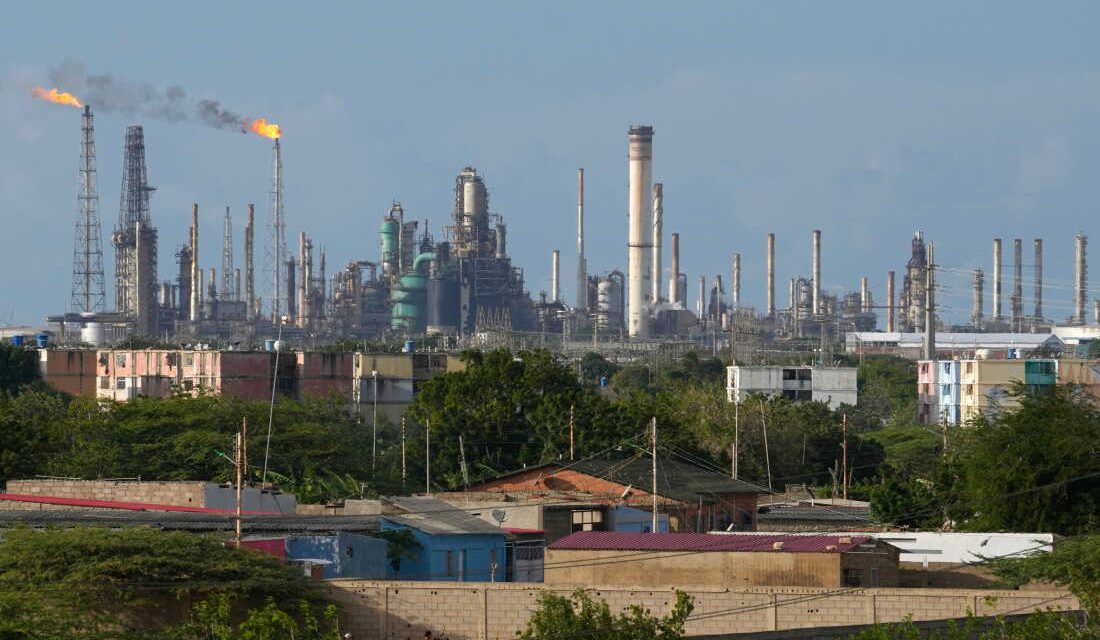
At a recent announcement, the White House revealed a partnership with North American Blue Energy Partners (NABEP) to tap into Venezuela’s oil reserves. This initiative, led by President Donald Trump, aims to establish a significant U.S. presence in Venezuela’s oil industry. The Pentagon is slated to gain partial ownership over a sizable portion of Venezuela’s oil reserves.
Trump hailed this as a landmark oil agreement, although experts express skepticism regarding its immediate impact on Venezuela’s oil production capacity. The deal includes creating a private company through a joint venture with NABEP, owned by Venezuelan businessman Alejandro Betancourt. Notably, NABEP ranks as Venezuela’s second-largest operator, succeeded only by Chevron.
Venezuela’s acting President Delcy Rodríguez has granted NABEP century-long rights over 17 oil fields, cumulatively amassing over 65 billion barrels in proven reserves. These fields were previously controlled by Russian and Chinese entities. Betancourt emphasized Venezuela’s rich natural resources and workforce, predicting substantial benefits for both Venezuelans and Americans.
The arrangement confers a 35% stake to the Pentagon’s Office of Strategic Capital, alongside an option for the U.S. to acquire 20% of the oil output at cost, facilitated by the State Department. Defense Secretary Pete Hegseth and Secretary of State Marco Rubio formalized this agreement. In an ambitious move, Betancourt’s company committed $100 billion towards modernizing Venezuela’s oil infrastructure.
Critics caution that the transaction poses political risks stemming from potential shifts in Venezuelan or U.S. governmental positions. Despite Trump’s assertions to the contrary, experts claim it might take years to rehabilitate Venezuela’s deteriorated energy sector. Additionally, Trump admitted that any reduction in U.S. gas prices will not be immediate.
Highlighting Venezuela’s heavy oil use, Trump foresees its role in replenishing America’s strategic oil reserves and producing essential goods like asphalt. Rodríguez has lauded the agreement as a pathway to revitalize Venezuela’s oil industry, stressing that national sovereignty remains intact despite criticisms of resource relinquishment.
“But we’re going to be taking all of that,” Trump remarked, underscoring the potential value in Venezuelan oil.
Legislative leaders urge more transparency regarding the agreement. Rep. Rick Crawford, chair of the House Intelligence Committee, voiced his eagerness for detailed information. Meanwhile, Sen. Jack Reed condemned the deal as misusing military resources for private gain, seeking legal clarification.
The announcement precedes Trump’s meeting with oil refiners to discuss increasing U.S. refining capacity. As the Iran war elevates gas prices, these lawmakers argue that increased refining capacity might reduce consumer costs. The meeting will involve Interior Secretary Doug Burgum, Energy Secretary Chris Wright, and Jarrod Agen, director of the White House National Energy Dominance Council.
 Flash Floods in Nepal & The Impact on Pilgrimage Sites
  Shanghai Cooperation Organization Summit Highlights Strategic Alliances
  Dolly Parton’s Legacy Celebrated with Dollyfest Event
  Concerns Over Military Resource Strain in the Iran Conflict
  President Trump Addresses Military Action Against Iran
  Challenges in U.S.-Venezuela Offshore Oil Agreement