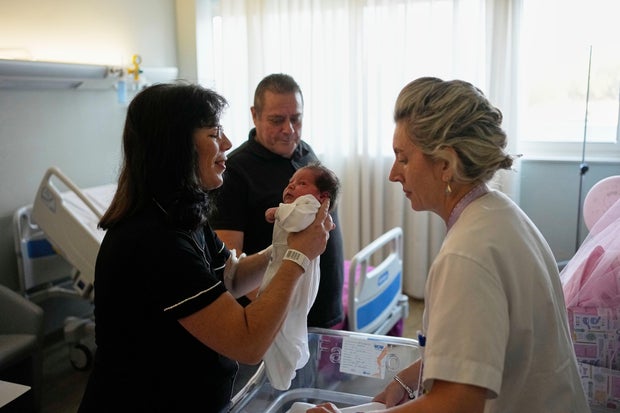
A Greek couple, Cristina Rapti-Tzelepi and Constantinos Raptis, faced a challenging journey to have a baby after the loss of their 21-year-old son in a road accident. They decided to use an embryo they had preserved over 22 years ago. This decision came as Cristina, 54, approached the legal age limit for in vitro fertilization (IVF) in Greece, which is 54 years old. She successfully gave birth to a healthy baby girl in Athens.
With only a narrow 2½-month window to secure approval from a national authority, the couple faced a race against time. “It was stressful, but with inner strength and our doctor and his team by our side, we got through every obstacle,” Rapti-Tzelepi told The Associated Press.
Their daughter, Georgia, was born weighing 7 pounds, 11 ounces. In a room filled with pink balloons and flowers, Rapti-Tzelepi expressed her hopes for Georgia. “We decided to give life a second chance, to make a new start, bring new life into our home and keep our family’s story going,” she said.
The baby’s conception from a 22-year-old frozen embryo is rare. In contrast, an Ohio couple recently had a baby from a 30-year-old embryo, which set a Guinness World Record for the oldest human embryo used in a successful pregnancy.
Dr. Kostas Pantos, the gynecologist who assisted Rapti-Tzelepi, emphasized the need to review Greece’s age restrictions, given the declining birth rate in the country. “The law is very strict: 54 plus one day is not allowed. Maybe it’s time for it to change,” said Pantos.
Constantinos Raptis, 60, expressed gratitude to Dr. Pantos for guiding them through their dark time. “He took us by the hand and pulled us out of our deepest darkness,” Raptis said.
Named Georgia in memory of their late son Giorgos, the couple remains open to the possibility of expanding their family further, potentially by seeking fertility services abroad.
Embryo donation is becoming increasingly popular in the U.S. According to a study in the American Journal of Obstetrics and Gynecology, transfers of frozen donated embryos nearly quadrupled from 2004 to 2019. The U.S. has over 1 million frozen embryos, with many people hesitant to discard them after completing their IVF cycles.
 Increased Use of GLP-1 Medications Among Young Adults: Examining Trends and Concerns
  Lisa Fasone’s Journey Through Prolactinoma and New Parenthood
  Examining Testosterone Therapy for Menopausal Women
  Impact of ‘Food Divorce’ on Relationships
  Long-Term Health Impacts of the 9/11 Attacks
  The Link Between Type 2 Diabetes and Mental Health Conditions in Women