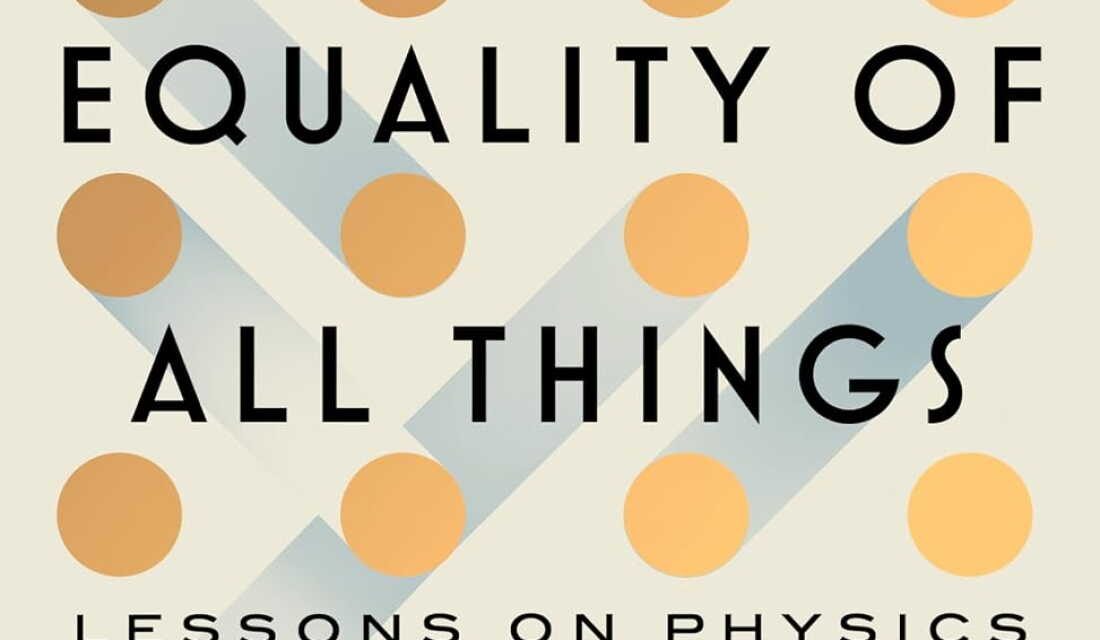
‘Physics and Ultimate Reality’ on many physicists’ shelves mirrors their early dreams of understanding the universe. This ‘God’s-eye view’ is pursued in many scientific texts. Yet Carlo Rovelli, a leading physicist, offers a contrasting perspective in his book ‘On the Equality of All Things.’
Rovelli argues that humans have limited perspectives concerning the universe. Living on a solid planet leads to assumptions about solid objects and fixed locations, which modern physics disproves. Albert Einstein’s relativity shows that our understanding of time and space is relative. Quantum mechanics indicates that properties of things relate to how they are measured.
Rovelli asserts that physics doesn’t offer an ultimate view. Instead, it provides a view from within. He supports the relational interpretation of quantum mechanics, a theory that emerged in the early 20th century. After Newton, scientists believed in an independent reality described by equations. Quantum mechanics questioned this by suggesting properties must be measured to be defined, as illustrated by Schrödinger’s Cat.
Some physicists tried to reclaim the notion of an absolute reality through interpretations that proposed parallel universes. Rovelli dismisses such ideas as impractical. He emphasizes relationality, where everything relates to everything else. Thus, properties are always relational, and ultimate perspectives do not exist.
Rovelli claims that physics cannot explain every aspect of the world. Understanding physical laws does not equate to understanding the world entirely. This argument contrasts with the triumphalist views in popular science books and challenges the views of many contemporary philosophers of science.
Rovelli also includes philosophical insights from Indian and Asian traditions, recognizing thinkers like Nagarjuna and Zhuangzi as equals to Western philosophers such as Plato and Aristotle. He values their different approaches to understanding reality.
Despite his critiques, Rovelli champions the power and promise of science. He proposes that science offers an invitation to creativity and knowledge, producing beauty and utility. He urges a change in perspective, advocating for humility amid the universe’s complexity.
‘On the Equality of All Things’ invites readers to reconsider human understanding and encourages future debates. Though Rovelli’s views may conflict with others like philosopher Henri Bergson, the book seeks broader engagement with these themes. Rovelli presents a fresh narrative, merging philosophy and science, to examine our universe’s intricacies.
Adam Frank teaches physics and astronomy at the University of Rochester. He is the co-author of ‘The Blind Spot. Why Science Cannot Ignore Human Experience.’
 Chimps and Self-Medication: Insights from Gombe Stream
  Legal Waiver for Sharing UAP Information Announced
  NASA Moves Upend Work on Space Projects at Goddard
  Preparation for El Niño: Protecting Livestock and Pets from Severe Weather
  Ancient Ring Sparks Debate Over Connection to Pontius Pilate
  Personality Traits, Genetics, and Health: A Comprehensive Analysis