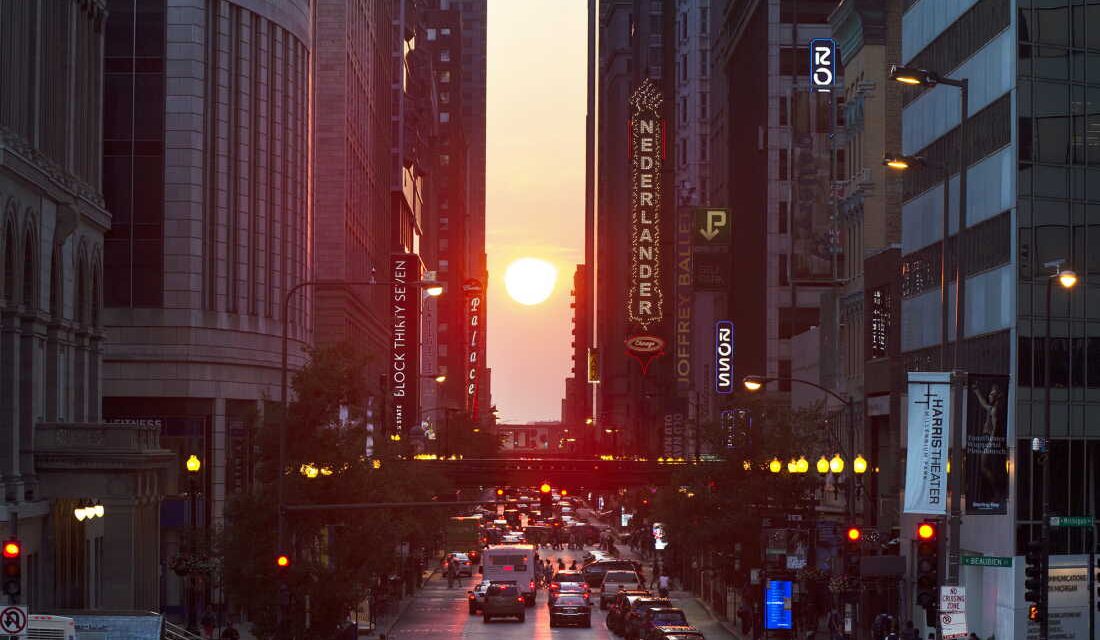
Each year, a unique event occurs in Chicago known as “Chicagohenge.” This phenomenon happens when the sun aligns perfectly with city streets like Kinzie and Madison. On one or two days, you can see the sun rise and set directly along these streets. This natural alignment was visible on September 22, 2017.
The fall equinox, marking the start of shorter days and a seasonal shift, offers an opportunity to observe this striking alignment in various U.S. cities. Streets that run east to west align with the sun during sunrises and sunsets, creating a visual spectacle reminiscent of ancient cultural practices such as those seen at Stonehenge.
Geoff Boeing, chair of the Department of Urban Planning and Spatial Analysis at the University of Southern California, explains that urban designs have long helped humans connect with the cosmos. “The things we built helped us to frame the universe in a certain way,” Boeing states, noting how structures and street layouts can shape our celestial views.
Chicago’s Urban Design and the “Chicagohenge” Effect
The towering buildings of downtown Chicago enhance this celestial event. According to Michelle Nichols, senior director of public programs at the Adler Planetarium, “The effect itself is accentuated by the height of the buildings and the width of the streets.” She points out that all you need is a wide, east-west running street and some elevation to take in the view.
This alignment, known as “Chicagohenge,” occurs due to Chicago’s street grid, which follows cardinal directions. Fans of this phenomenon liken it to Stonehenge because of its solar alignment. Similar occurrences can be seen in other grid-patterned cities like Washington, D.C., and Phoenix.
A Historical Perspective on Urban Layouts
Cities have historically been planned with a connection to celestial events. Boeing remarks that many early cities were designed with “cosmic urban plans” to align with stars and planets. Tenochtitlan, now Mexico City, was one such city carefully laid out with astronomical knowledge.
In contemporary cities, these ancient alignments find new form in modern infrastructure. Even though the alignment might be accidental today, it still allows people to experience an age-old connection to the sky. Nichols emphasizes that “we don’t rely on these alignments to tell us things, but they are really great reminders that, hey, the sky really is still up there.”
Experiencing “Henge” Alignments Safely
Photographers and onlookers are drawn to capture these moments, making them popular on social media. Nichols warns of safety concerns during these events. “Don’t walk out in the middle of the street to take the perfect photo,” she advises, reminding people to stay on sidewalks.
Drivers should be cautious as well. On east-west streets, the low-hanging sun can cause glare, complicating visibility. “You do see traffic buildups and backups because of the location of the sun in the sky,” Nichols notes, adding a practical safety tip for those caught in traffic during these celestial alignments.
 Discover Five Simple Art Projects to Try at Home
  Turning Home Food Waste into Compost: A Guide
  Fat Bear Week 2026: A Look at the Contest and Its Competitors
  Navy Veteran Generald Wilson Reflects on Emotional National Anthem Performance
  Lucas Museum of Narrative Art: A New Cultural Landmark
  Northlight Theatre’s ‘The Front Page’: A Satirical Nod to Chicago’s Journalistic Past