
President Donald Trump has recently compared the unemployment rates of Canada and the United States, highlighting a difference amid the ongoing trade tensions between the two nations. The current trade dispute began when Trump imposed tariffs on Canadian products in March 2025.
Trump has touted the U.S. unemployment rate, which stands at 4.1% as of August, while criticizing Canada’s rate as being higher, allegedly around 10%. However, data from Statistics Canada shows Canada’s unemployment was 6.4% in August. The last occurrence of a 10% rate in Canada was in August 2020, when the U.S. had an unemployment rate of 8.4%.
Current Unemployment Statistics
According to official records, the U.S. unemployment rate for August was 4.1%, whereas Canada posted a higher rate of 6.4%. This suggests a stronger labor market in the United States, signified by lower unemployment figures. Over the past year, Canada has shown larger improvements in its unemployment rate compared to the U.S.
Economist Peter Morrow from the University of Toronto affirms the strength of the U.S. economy and labor market. The U.S. economy has outperformed Canada’s for a while, offering a favorable employment environment.
Impact of Trade Policies on Employment
Trade tensions and tariffs can potentially affect employment rates in various sectors such as the auto, steel, and aluminum industries. Although the Canadian unemployment rate slightly improved from 6.8% in March 2025 to 6.4% in August 2026, the U.S. also saw an improvement from 4.2% to 4.1% in the same period.
Canada remains vulnerable to trade disruptions, according to Morrow. While trade impacts can influence hiring trends, Canadian businesses show caution in expanding workforces amid uncertainty.
Retaliatory tariffs from Canada may impact U.S. industries exporting goods, potentially slowing down hiring or leading to layoffs. U.S. companies using Canadian materials might experience increased costs, affecting their expansion and hiring plans.
U.S. Regional Unemployment Disparities
Unemployment varies across the U.S. with Washington, D.C., showing the highest rate at 5.7%, followed by California and Connecticut at 5.1%. States with lower unemployment rates include South Dakota at 2%, North Dakota at 2.2%, and Vermont at 2.6%.
Employee Confidence Despite Low Unemployment
Despite low overall unemployment, U.S. workers exhibit low confidence in their employers’ futures, with slow hiring and recent layoffs in certain sectors. Glassdoor’s Employee Confidence Index fell to 42.9%. Factors contributing to this include job security concerns and rising costs, as explained by Michael Ryan, a finance expert.
Future Outlook
It’s uncertain how either country’s job market will respond to ongoing trade tensions. Economists will continue to monitor employment trends closely as the trade dispute between the U.S. and Canada persists. The U.S. economy will be a focal point for voters as midterm elections approach, regardless of changes in unemployment rates.
 Washington’s Intense Focus on AI: Balancing Risks and Opportunities
  Democratic Candidate Mary Peltola Challenges Republican Incumbent in Alaska
 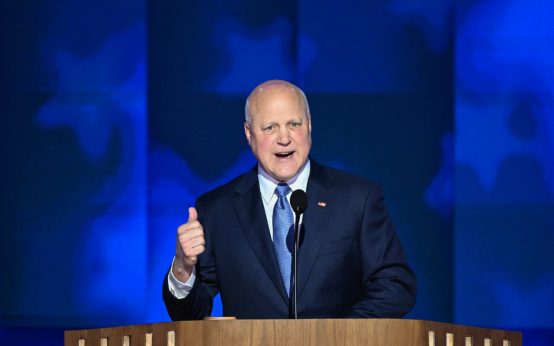 Mitch Landrieu Contemplates Presidential Run and Discusses Political Landscape
  Strategic Capital: A Tool for U.S. Defense
  News Outlets Seek Court Intervention Against Trump’s Ban
  DHS Warns Migrant Caravan Heading to U.S.-Mexico Border