As Super Bowl 60 approaches, there might come a pivotal moment when the New England Patriots encounter a crucial fourth-and-short situation in the red zone. In that moment, coach Mike Vrabel will have to decide whether to opt for a conservative approach or trust the data-driven decision-making offered by analytics.
In contrast, if the Seattle Seahawks find themselves in a similar scenario, it’s likely that the decision will lean towards taking the safe points. This reflects the tendency of Seahawks coach Mike Macdonald, who frequently opts for field goals in such situations. The phrase ‘take the points’ has become a divisive topic in football circles. The modern era of play calling often favors taking risks by going for it on fourth down, especially deep in enemy territory, based on the belief that successful conversions are more beneficial than the cost of failure.
The trend of going for it on fourth down is evident on football fields across America, with coaches at both the college and professional levels increasingly embracing analytics. However, this approach often sparks debates among fans and analysts regarding the appropriateness of such decisions.
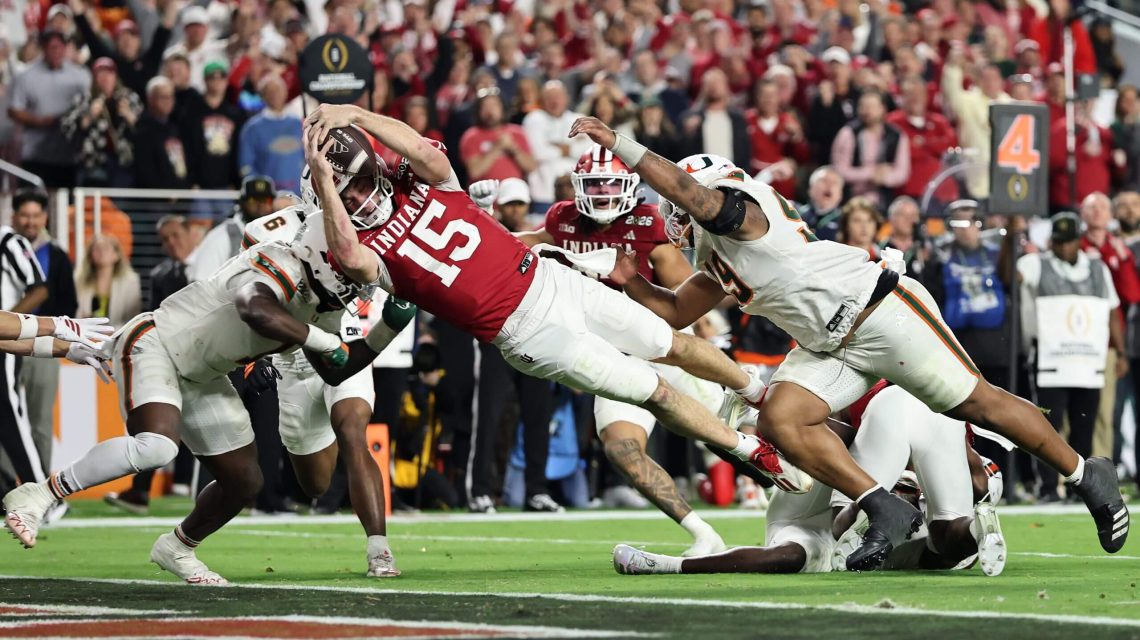
In a memorable instance, the Denver Broncos lost the AFC Championship Game after coach Sean Payton opted to go for it on a fourth-and-1 opportunity from the Patriots’ 14-yard line in the second quarter, resulting in a failed conversion attempt. Conversely, Indiana Hoosiers’ coach Curt Cignetti’s gutsy fourth-and-4 call from Miami’s 12-yard line led to a decisive quarterback draw by Fernando Mendoza, which secured them the national championship.
These examples illustrate two similar decisions resulting in dramatically different outcomes. One team won a title, while the other suffered a narrow defeat. Despite the controversy, analytics-driven strategies appear to be gaining traction, with NFL teams opting to go for it on nearly 34 percent of fourth-down plays in opponent territory in 2025, marking a record within the last 25 years, according to TruMedia data.
Prominent football figures, however, have voiced skepticism toward the heavy reliance on analytics. Coach Mike Martz, known for orchestrating the explosive “Greatest Show on Turf” offensive strategy, criticizes the prevalent use of analytics, claiming they reduce the game to impersonal numbers and detract from the human element. ‘Numbers shouldn’t dictate every decision; it’s always about the people,’ he contends.
Martz emphasizes that decisions based on analytics might overlook the unique dynamics specific to each game, such as personnel, play calling, and defensive formations. He argues that the context of a fourth-and-1 situation is uniquely different for every team, and criticism stems from applying general analytics to individualized moments in the game without factoring in such nuances.
The mathematical rationale supporting going for it on fourth down is relatively straightforward: the potential boost to win probability afforded by a conversion outweighs the downside of handing the ball over to the opponent. Recent changes to the NFL’s kickoff rules have further influenced this data, shifting the average starting field position for teams to their 30-yard line after a kickoff.
However, Martz notes the psychological aspect of coming away empty after a lengthy drive, suggesting that sometimes it’s necessary to ‘take the points.’ Statistics show that, while kickers have made 97 percent of their short-distance attempts, teams successfully convert fourth downs only 57 percent of the time. Fans often question turning down a nearly certain field goal attempt for a far riskier fourth-down conversion.
Data from recent seasons underscores the shift, with more teams going for it on fourth down in the red zone and converting at slightly better-than-average rates compared to previous years. Despite this, Martz believes that while analytics and technological integration into football are here to remain, they are not a substitute for the coaching instincts and insights derived from experience. He emphasizes the need to balance analytics with a game-time intuition, ensuring strategic moves reflect the complexities and nuances of live sports.
Martz articulates his reservations, asserting that the human element is essential to football, and over-reliance on analytics could potentially undermine it. ‘There’s a disturbing tendency for teams to rely too heavily on numbers, potentially at the expense of sound, situational decision-making,’ he cautions.
 Ronald Acuna Jr. Suffers Injury During Game Against Cincinnati Reds
  Joe Burrow’s Unexpected Post-Game Recovery
  Rangers Place Players on Waivers Ahead of Season Opener
  Cubs Face Crucial Pitching Decisions Amid Wild Card Race
  Chicago Cubs vs. Miami Marlins: 12-Inning Game Recap
  Alabama Football’s Comeback and Controversy