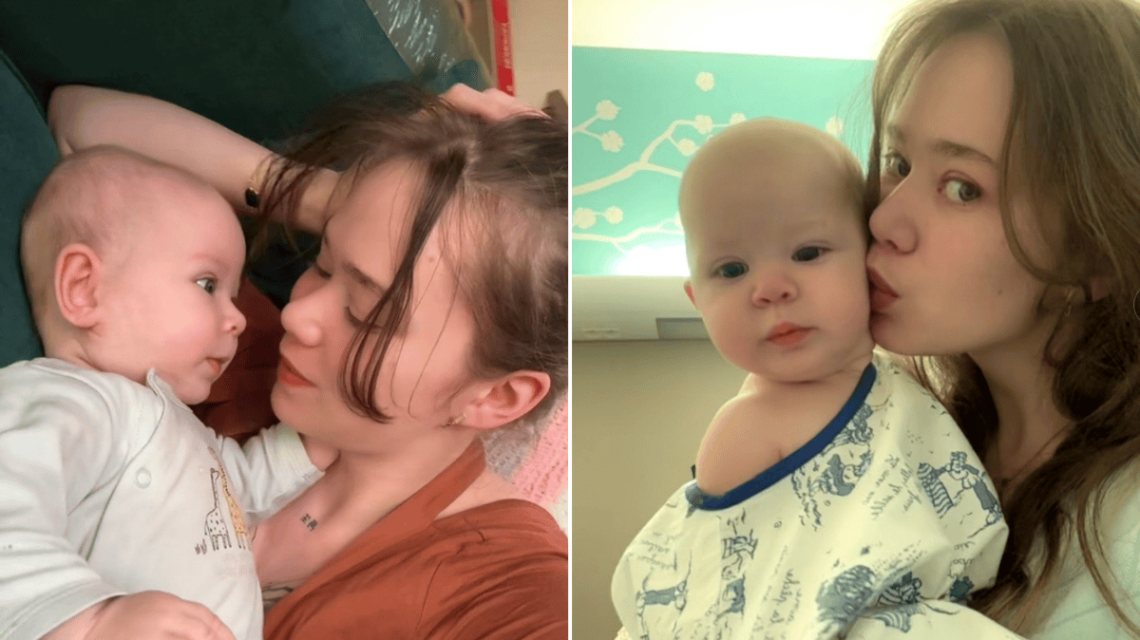
Marcelle Miller faced a life-altering moment when she discovered her three-month-old daughter had a rare congenital condition. Up until then, Miller’s pregnancy had been smooth.
“My pregnancy went really well,” she shared. “I only had a slight placental hematoma, but it resolved with rest. I didn’t even experience morning sickness.” At 22, Miller was thriving as a realtor in Europe. Her daughter was born after 42 weeks of gestation following 21 hours of labor, with seven minutes of pushing, a healthy baby.
“Everything was perfect,” Miller added, recalling how things changed when her daughter turned three months old. She noticed a small, cloudy ring in her daughter’s right eye. Concerned, she sought medical advice.
Discovering Congenital Cataracts
Research led her to learn about congenital cataracts, a condition where a baby is born with a cloudy lens. This affects roughly three to four in 10,000 births in the U.S., leading to vision problems and eye misalignment. Treatment often involves early surgery, followed by visual aids like glasses or contact lenses.
Miller hoped for a different diagnosis, but a doctor confirmed her fears. Her daughter had bilateral congenital cataracts. “My life came crashing down. It felt like my daughter’s future was suddenly in jeopardy,” she admitted. Miller felt she had lost the future she envisioned for her daughter.
Congenital cataracts can result from genetic mutations, metabolic disorders, or infections during pregnancy. While doctors continue to investigate, they suspect a genetic mutation in her husband’s blood might contribute to the condition, although not directly causing it.
Treatment and Future Prospects
Miller immediately sought treatment for her daughter. “The condition is serious,” she said, recalling how specialists treated her daughter. The surgeries involved removing clouded lenses, then replacing them with artificial ones. Now, visual aids are necessary to support development.
Four surgeries later, her daughter manages without visual aids, but refuses to wear glasses and requires contact lenses. “Her eyesight is starting to plateau,” Miller explained. “But it’s not noticeable unless you know she has this health issue.”
Miller admits the process has been tougher on her than her daughter, who was too young to comprehend the magnitude of the situation at the time. More surgeries loom, but Miller remains hopeful for a less invasive future.
Miller encourages other parents facing similar diagnoses to maintain hope. “Our children will lead normal lives without feeling different. As parents, we need to adjust our expectations,” she reflected.
 Family Seeks Answers in Daniel Magaña’s Jail Death
  Facing Pancreatic Cancer: Vicky Titcomb’s Journey
  A Pressing Solution for Alzheimer’s
  Understanding the Perils of Ectopic Pregnancy
  Concerns Over Medicaid Cuts for Autism Therapy in Georgia
  Addressing Poverty in Medical Practice