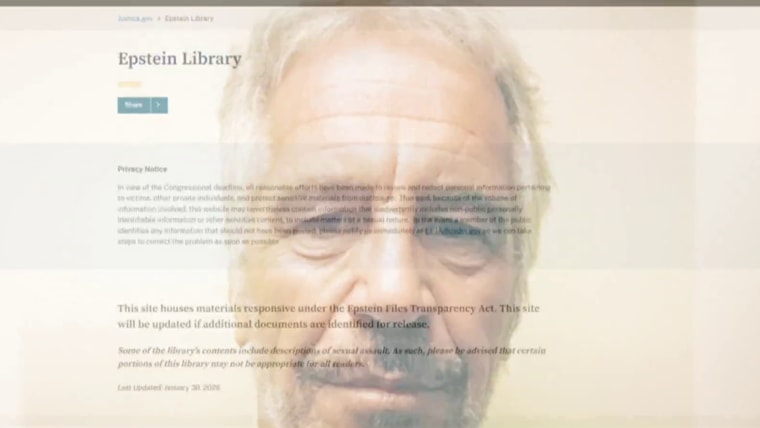
An arrangement between the Justice Department and several survivors of Jeffrey Epstein has encountered significant issues after the agency failed to adequately redact personal information in some documents. These documents were released last week, and despite assurances, the identities of several victims remained accessible as of Wednesday, as highlighted by attorney Brittany Henderson to NBC News.
Henderson, who is legal counsel to multiple Epstein survivors, expressed the survivors’ reliance on the Justice Department to rectify its redaction oversights by noon on Wednesday. “For five days, the Department of Justice has left the survivors of Jeffrey Epstein publicly exposed — named and personally identified on the government’s own website — despite acknowledging that these disclosures were wrongful and agreeing to correct them immediately,” she remarked.
She stressed that the availability of the Epstein documents online has made the harm permanent, stating, “The documents have been downloaded, copied, and preserved, rendering the harm permanent and impossible to correct.” Every additional moment that these records are online increases the risk for women who did not seek public attention and were supposed to be protected by law.
“Our primary aim is the full removal of any document that names a survivor,” Henderson insisted. She called upon the media and public to show restraint and not to republish the names of the affected women, arguing, “the fact that a disclosure occurred does not make it ethical or just.” The Justice Department was not immediately available for comments on Wednesday.
U.S. District Judge Richard M. Berman canceled a hearing scheduled for Wednesday that would have addressed protections for Epstein survivors. He was “pleased but not surprised” by the resolution of privacy issues between the involved parties. Included in the order to cancel the hearing was a letter from Henderson, which mentioned “extensive and constructive discussions” between the victims’ representatives and the government concerning the recent redaction issues in Epstein-related materials.
The Epstein Files Transparency Act, signed into law by President Donald Trump in November, imposed a requirement on the government to release all Justice Department files related to the Epstein case within a 30-day timeframe. Additionally, it obligates the Trump administration to explain any redactions to Congress.
Over 3.5 million pages, along with thousands of photos and videos, were released on Friday after missing a December deadline for turning over unclassified documents. Despite prior assurances from the Justice Department to safeguard privacy, incomplete redactions exposed the names and personal details of various survivors to the public. Henderson noted that this failure revealed the identity of at least one woman who had not previously disclosed allegations of abuse.
One of the survivors, Danielle Bensky, commented on the breach of confidentiality regarding her conversations with FBI investigators, which were part of the document release. Bensky, who claims Epstein abused her as a teenage ballerina two decades ago, expressed doubt about the incident being accidental. “I thought it was carelessness, and then I went to incompetence,” Bensky recounted to NBC News. “And now it feels, it feels a bit deliberate. It feels like a bit of an attack on survivors.”
This report is contributed by Chloe Atkins from the NBC News National Security and Law Unit based in New York, with additional information from Hallie Jackson, senior Washington correspondent for NBC News.