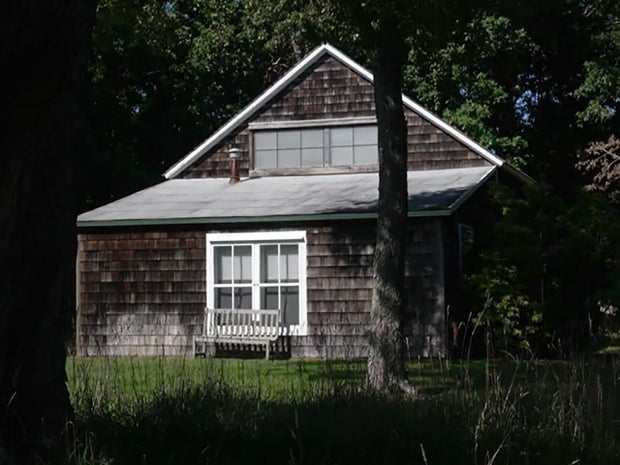
The Pollock-Krasner House and Study Center, situated in the hamlet of Springs, New York, offers a glimpse into a significant part of modern art history. This old farmhouse on Long Island’s east end was the residence and workplace of abstract expressionists Jackson Pollock and Lee Krasner from the winter of 1945.
The house itself, which lacked basic amenities like plumbing and heating, was a deliberate choice by Pollock and Krasner. Their move aimed to create an isolated environment conducive to intense artistic focus, explained Matthew K. Ward, director of the Center. Today, Stony Brook University maintains the site, preserving its historical significance.
Ward demonstrated Pollock’s custom speaker system, wired through a crawlspace and covered in paint. This anecdote exemplifies how intertwined art and life were for this creative duo. Pollock’s studio had no easel; he famously placed his canvases on the floor, pouring, dripping, and splattering paint. The barn floor, as Ward noted, remains a testament to Pollock’s physical style of painting.
This rustic space was where the art world saw tremendous change. In 1949, Life magazine pondered whether Pollock was America’s greatest living painter. Yet, questions often arise about Lee Krasner’s contributions.
The Metropolitan Museum of Art in New York City addresses this with an exhibition titled “Krasner and Pollock: Past Continuous.” Curators Brinda Kumar and David Breslin aim to illustrate the artists’ simultaneous careers through creative adjacency. Visitors see Krasner’s work next to Pollock’s, facilitating understanding of their artistic dialogue.
Pollock and Krasner’s origins were diverse, with Pollock hailing from Cody, Wyoming, and Krasner from Brooklyn as the child of Jewish immigrants. Breslin attributes their bond to shared intelligence and boldness. Pollock’s magnetism lay partly in Krasner’s curiosity about the man behind the art.
Their relationship was complex, affected by Pollock’s alcohol use and infidelity. In the mid-1950s, Krasner moved to Paris while Pollock remained in Springs with Ruth Kligman. Breslin notes a downward spiral followed, culminating in Pollock’s death in a 1956 car crash.
Upon returning to Springs, Krasner took control of her late husband’s studio. Breslin credits this transition with unleashing her creative potential. Kumar elaborates that moving into the barn allowed her to explore large-scale painting, evident in works like “Through Blue,” “Right Bird Left,” and “Combat.”
Even years after Pollock’s death, Krasner continued to live and work in Springs, leaving ghostly outlines on the walls from her canvases. Ward emphasizes Krasner’s efforts to preserve both artists’ legacies.
The exhibition at the Met challenges longstanding misconceptions, presenting Krasner as Pollock’s equal. It strives to reshape history by highlighting both artists’ achievements.
“Krasner and Pollock: Past Continuous” presents an opportunity to appreciate the intertwined careers of these influential artists, providing insights into their pioneering contributions to modern art.
For more information:
- “Krasner and Pollock: Past Continuous,” at the Metropolitan Museum of Art, New York City (through January 31, 2027)
- Exhibition catalogue: “Krasner and Pollock: Past Continuous” by David Breslin and Brinda Kumar (Metropolitan Museum of Art), available in hardcover through Amazon, Barnes & Noble, and Bookshop.org
- Pollock-Krasner House and Study Center, Hampton, N.Y.
Photographs courtesy of Pollock-Krasner House and Study Center, East Hampton, N.Y. © 2025 Pollock-Krasner Foundation/Artists Rights Society (ARS), New York.
 AI’s Growing Influence in Literature
 Bayeux Tapestry Visits England After Almost a Millennium
 Conor Kennedy and Giulia Be’s Three-Day Wedding Celebration in Rio de Janeiro
 LA28 Olympics Arts Program Faces Coordination and Funding Challenges
 America Unites to Remember Dale Earnhardt
 Amanda Seyfried’s Decision Against Intimate Scenes Reflects Changing Boundaries in Hollywood