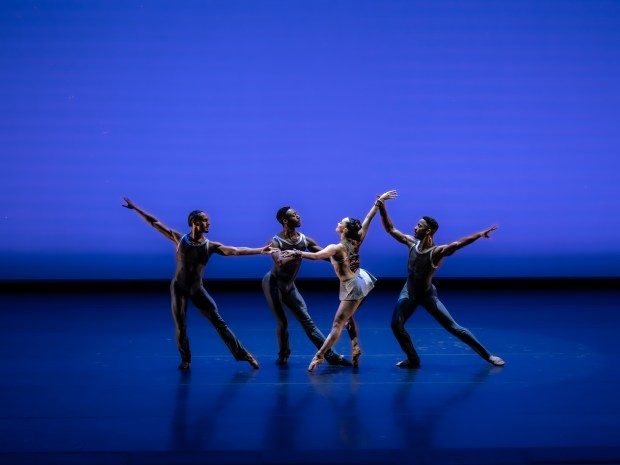
Robert Garland’s ballet “Return” served as a significant opening in numerous ways. It marked the Dance Theatre of Harlem’s return to Chicago after a decade-long absence. The plotless, neoclassical funk ballet, crafted in 1999 to music by James Brown and Aretha Franklin, represents what Garland, the artistic director, called “all of him in one place” during his curtain speech. This sentiment embodies the heart of this distinguished company. The performance, presented for one night only at the Auditorium, inaugurated its season, spotlighting North American dance.
Arthur Mitchell, a New York City Ballet principal dancer, founded the Dance Theatre of Harlem in 1969 amid the Civil Rights Movement. He initially offered ballet instruction out of a Harlem garage when Black representation in ballet was rare. Although some progress has been made, American ballet has been slow to evolve into the inclusive art form George Balanchine envisioned with New York City Ballet. Observers still often see only one or two dancers of color on American ballet stages. Balanchine confronted persistent headwinds, demonstrated by the fact that about 10% of NYCB’s current roster is Black. In contrast, Mitchell advanced, realizing his vision that ballet belongs to everyone.
The return of the Dance Theatre of Harlem, nearing its 60th anniversary, signifies resilience. The company had been forced into a hiatus due to financial challenges, lasting eight years despite being intended as a short break. It returned to Chicago in 2014, shortly after its rebirth, featuring Garland’s “Return” and other archival works. In 2016, it reappeared as a leader in Black artistry, infusing works with the era’s social and political energy. Since then, it hasn’t performed in Chicago.
The enthusiastic attendance at the Auditorium wasn’t solely because of this absence; it echoed Garland’s comment about merging classical ballet with funk-soul music, exemplified in performers Carly Greene and Micah Bullard’s showcase during “Return.” Their solo movements, glimpsed under Pamela Allen-Cummings’ mod-inspired costumes, shifted from hip hop-inspired undulations to precise pirouettes. Roma Flowers’ lighting echoed these transitions, moving from classic silhouettes to vivid discotheque environments.
This versatility isn’t accidental, and dancers must embrace the stylings of “Return” alongside pieces like “Donizetti Variations.” This restaging of Balanchine’s 1960 peasant-themed work demands elegance. Paired with Garland’s creations, the contrast says, “We excel here, too.” The performances, especially in “Donizetti’s” intricate sequences, dazzled. Perhaps “Donizetti Variations” may show Balanchine’s style age, yet the performance remains impressive.
In contrast, “Firebird,” a timeless piece, completed Saturday’s program. Created by John Taras in 1982, this one-act ballet draws from a Russian fairy tale first choreographed by Michel Fokine in 1910. Commissioned by Serge Diaghilev with music by Igor Stravinsky, the original “Firebird” was performed by Ballets Russes, offering iconic works like “The Rite of Spring.” Taras, who danced with both Fokine and Balanchine, later created his version, relocating “Firebird” to a Caribbean setting. Geoffrey Holder’s set and costumes evoke a tropical paradise full of vibrant wildlife.
The story unfolds with a man (Derek Brockington) finding a mysterious bird (Alexandra Hutchinson) that offers a feather as a keepsake. This feather aids him when threatened by an evil prince (Jhaelin McQuay) against his love for a “Princess of Unreal Beauty” (Kamala Saara). Brockington effectively calls Firebird for assistance. Hutchinson embodies Firebird with a combination of elegance and avian movement, accentuating her physicality with elaborate gestures and costume features.
Consistent with fairy tale traditions, the narrative concludes with a positive resolution. Firebird saves the day, her presence lingering above the stage. This rendition of “Firebird,” a key work for the Dance Theatre of Harlem, may display its 1980s roots through its fairytale aesthetic, yet it surpasses temporal constraints. Dubbed a “roving Balanchinian” by The Guardian, Taras spread ballet’s plotless concept worldwide. “Firebird” was a narrative embraced by both Taras and Balanchine, and this production aligns so closely with Fokine’s original it could belong to Ballets Russes itself. Combined with the Dance Theatre of Harlem’s graceful dancers, the night provided an exceptional experience.
Lauren Warnecke is a freelance critic.
 Rosalía on Her Album ‘Lux’ and Musical Journey
 Rikki Rockett’s Battle Against Cancer and His Journey to Recovery
 Celebrating John Turturro: A Life in Character Acting
 Sylvester Stallone Defends Casting His Daughter in ‘Tulsa King’
 Kevin Pollak Remembers Rip Torn’s Unusual On-Set Behavior
 Megan Fox Embarks on New Business Venture with Subs.com