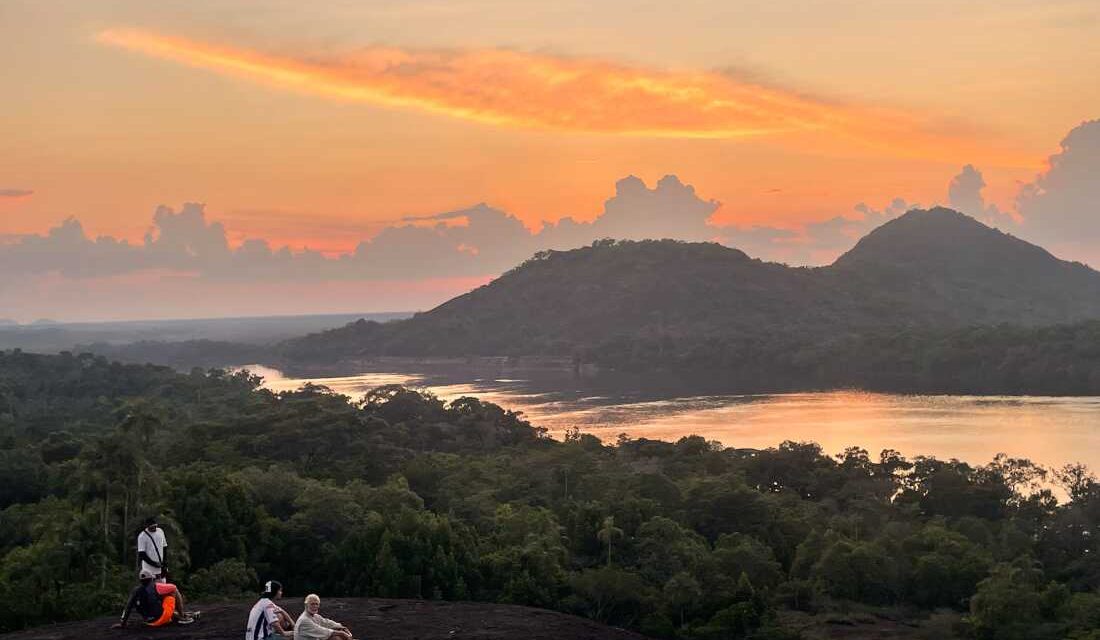
Sunset paints a warm glow over Colombia’s remote Mavecure Mountains. Here, three towering rock formations emerge from the Amazon jungle.
Immersed in Nature’s Sounds
The Amazon rainforest comes alive with howler monkeys, parrots, and frogs at the crack of dawn. On a visit with American friends, the landscape around us in eastern Colombia appears endlessly flat until we spot three massive rock formations: the Cerros de Mavecure. These formations rise dramatically 2,000 feet above the jungle floor. Comprising sandstone, shale, and quartz, they look like Rio de Janeiro’s Sugarloaf Mountain but carry a different name. ‘Mavecure,’ our guide Ignacio Rodriguez explains, refers to poison-dart blowguns used by the Indigenous groups in the area. These mountains hold sacred significance for the Puinave and Curipaco Indians, who often climb the peaks to make spiritual offerings.
The Rewarding Climb
Marcela Sánchez, an industrial engineer from Cali, calls the view ‘divine.’ Reaching the top of the smallest peak takes two hours in 90-degree heat. Guide ropes and ladders assist climbers, providing scenic stops for hydration. Despite the effort, the view from the summit makes the climb worthwhile. The Mavecure mountains exemplify Colombia’s tourism potential, showcasing the country’s rich biodiversity. In addition to the Amazon jungle, Colombia boasts Caribbean beaches and Andean Mountain ranges. With 1,900 bird species, the country is a bird-watcher’s paradise.
A Shift in Tourism
For decades, Colombia struggled with guerrilla warfare and drug-related violence deterring visitors. A peace treaty in 2016 changed the narrative, inviting tourists back. By the first eight months of 2025, Colombia welcomed a record 3.1 million international visitors.
‘Tourism has become the local economy’s main engine,’ says Delio Agapito, Remanso’s mayor. Many residents near Mavecure have transitioned from gold mining, which caused environmental damage, to tourism-related careers. Fabio Pérez, once a gold miner, now manages a hostel and an apiary, selling honey to tourists. He shares, ‘Tourism improved our quality of life. I am with my family now.’
Challenges and Hopes
Compared to Colombian hotspots like Cartagena or Medellín, Mavecure attracts fewer visitors. The absence of roads connecting to the site, sporadic flights, and rustic accommodations contribute to this. Fernando Carrillo, who runs the environmental foundation Aroma Verde, acknowledges, ‘Tourism here is small-scale.’
As we continue our ascent, Rodriguez cautions against grabbing bushes, which may have thorns, and warns about potential snake encounters. However, our climb is snake-free. Nearing the top, we meet other climbers enjoying the adventure. Guide Ignacio introduces edible rainforest ants. Colombian anesthesiologist Sebastian Rivera tries one and comments on its unexpected lemon-like taste.
A Unique Experience
Finally reaching the summit, climbers experience a panoramic view of the jungle and Inírida River, framed by Mavecure’s towering peaks. ‘This is a dream come true,’ says Catalina Laverde, who climbed with friends. Rivera, enjoying the less crowded experience, reflects, ‘It’s not the five-star resort, but you do get these natural wonders.’
 FAA Proposal on Flight Attendant Breaks Faces Union Opposition
  State Department Alerts on Middle East Travel Amid Rising Tensions
  Midair Brawl Erupts on London-Bound Flight
  Historic Los Angeles Building Transformed into Boutique Hotel
  Las Vegas Tourism and Economic Shifts in 2025
  Mallorca’s Strategy to Address Overtourism: Attract Wealthy American Tourists