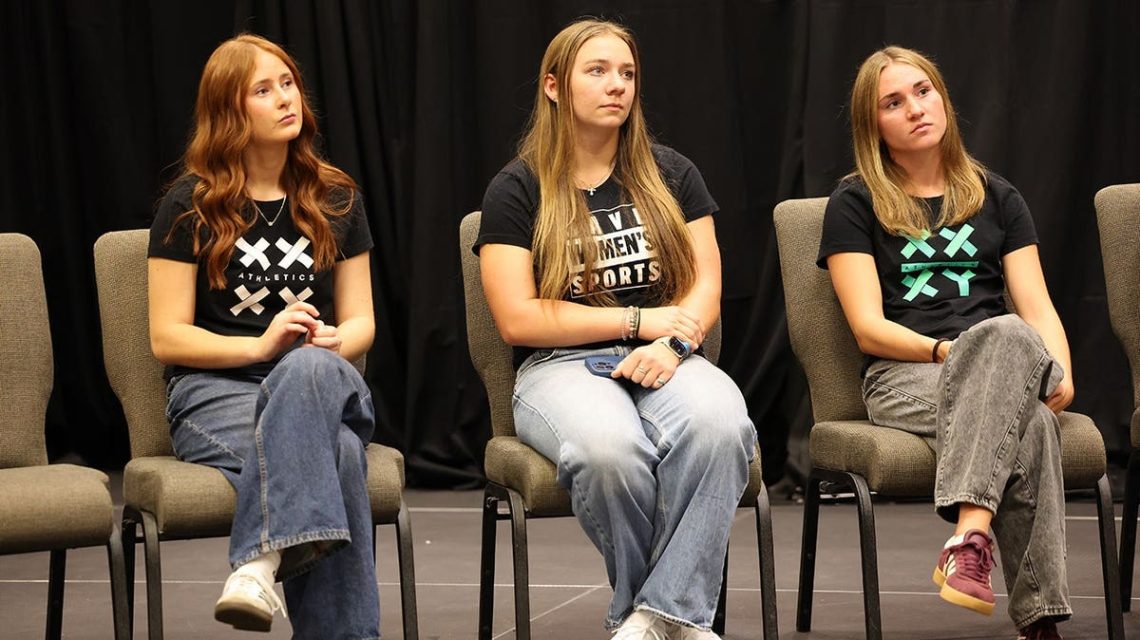
In Redmond, WA, Tumwater High student Frances Staudt celebrated a potential victory for the separation of boys and girls in K-12 sports. Washington’s Initiative 638 showed a strong lead in unofficial election results, suggesting it might require athletes to compete based on their biological sex. Staudt, at a watch party organized by Let’s Go Washington, expressed joy over the results, stating, “We did it!” She described enduring harassment since refusing to play basketball against a biological boy.
During a rally, female athletes Frances Staudt, Bailey Andersen, and Sadie Sullivan voiced their experiences of competing against biological males in sports. The rally aimed to support the initiative, which at the time had a 13.6% lead for “yes” votes with 60% of ballots counted. Prediction market Kalshi rated its chance of passing at 91%. Approval would signify two major firsts: the first voter-approved statewide law separating K-12 sports by sex and the first in a blue state. Previously, 27 predominantly Trump-won states enforced such separation through legislative means.
“I think this is a big bellwether for the state,”
stated Let’s Go Washington founder Brian Heywood.
Heywood highlighted the bipartisan nature of the issue, focusing on fairness in girls’ sports rather than partisan politics. If the initiative passes, it could take effect within 30 days.
Girls at Tumwater High School protested a transgender athlete’s victory in a state track event, sparking further debate. Heywood’s initiative, filed in June 2025, required 309,000 signatures to reach the ballot, ultimately gathering over 445,000. Notably, Staudt and other athletes aided in this effort. The campaign spotlighted a transgender runner at Camas High School who switched teams, leading to significant controversy.
The runner placed 76th in a boys’ junior varsity event, later competing and succeeding in girls’ races. Critics warned of disadvantages for female athletes aspiring for regional and state contests. The controversy peaked in October when female teammates protested a meet, fueling support for Initiative 638.
Women’s sports advocate Amy Sousa, who chronicled the protest, championed restrictions on transgender athletes for nearly a decade. Despite unofficial election counts, she praised the measure’s promising outcome. Sousa stressed the importance of safeguarding Title IX and sex-based protections for female athletes.
Simultaneously, Colorado’s Proposition 134, resembling Washington’s initiative, showed a narrower lead. Extending beyond K-12, it proposed sex-based criteria for college sports as well. At a watch party, Amy Sousa reaffirmed the bipartisan message, emphasizing fairness in girls’ sports rather than political divides.
In Arizona and Nebraska, additional ballot measures addressed sports-related restrictions, affecting transgender athletes’ participation. Nebraska’s Initiative 442 aimed to enshrine existing rules in the state constitution, thereby reducing chances of repeal.
Arizona’s Proposition 318 proposed expanding current restrictions to private schools and athletic associations, also incorporating locker room and restroom requirements. Amidst these developments, Washington and Colorado’s votes captured attention, reflecting on long-standing calls for reform from young activists like Staudt. Adults are seemingly responding to these appeals.
Matt Calkins, columnist at Outkick, covers the intersection between sports and culture. Previously, he worked with Seattle Times, San Diego Union Tribune, and Vancouver Columbian. Follow him on X @matt_calkins.
 Russell Wilson Considers Coaching Role at NC State
 Luka Doncic’s Historic Scoring Run Highlights Lakers’ Rise
 Joe Fagnano to Make NFL Debut as Ravens’ Starting Quarterback
 Seattle Seahawks Experience Difficult Night Against Chicago Bears
 Spanish Soccer Player Jesús de Miguel Dies After Game Collision
 The Game: A Deep Dive into NFL History with Peter King