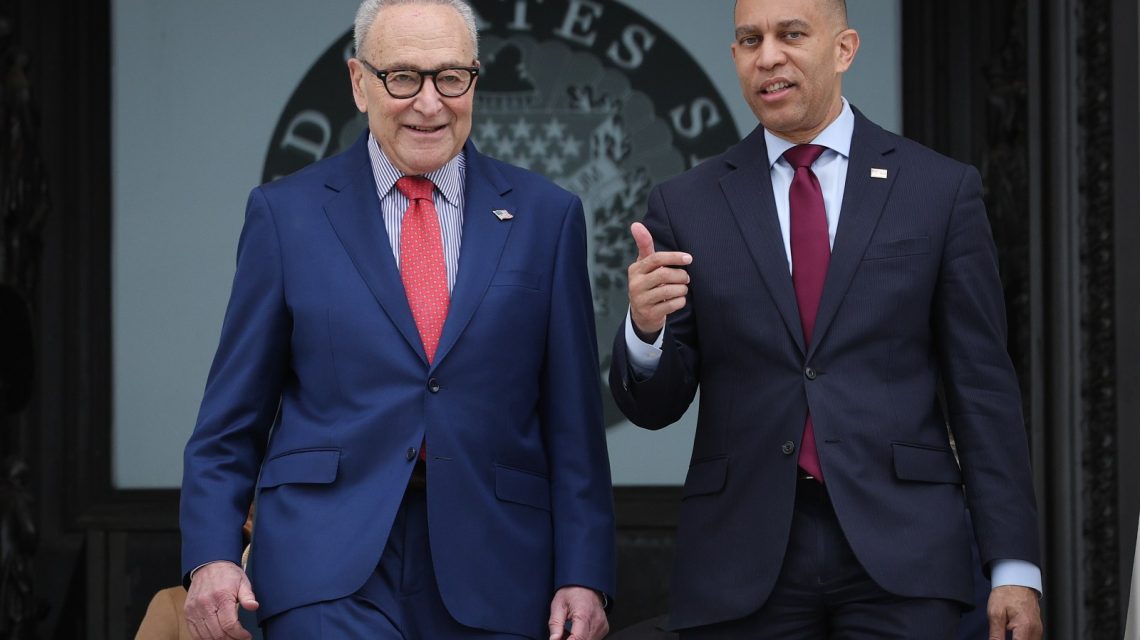
Hakeem Jeffries, House Minority Leader, is moving toward the speaker’s position following Democrats’ successful midterm elections. Despite this, a recent Economist/YouGov poll from October 23-26 showed that only 26% of registered voters approved of Jeffries. Meanwhile, 47% disapproved. Mike Johnson, the current Speaker and a Republican from Louisiana, had better ratings with 32% approval and 45% disapproval. The poll surveyed 1,440 registered voters with a margin of error of about 3 percentage points.
Senate Minority Leader Chuck Schumer, another New York Democrat, showed the lowest approval among the four congressional leaders. His ratings were 24% approval and 54% disapproval. Senate Majority Leader John Thune, a Republican from South Dakota, had lower approval at 21% but fewer disapproved of him at 46%.
Petitions have been emerging since elections calling for new Democratic leadership in Congress. These petitions have amassed hundreds of thousands of signatures. Some new senators plan to vote against Schumer. However, no declared challengers have emerged against either Jeffries or Schumer. Internal caucus numbers appear to favor them.
The poll did not capture potential boosts from post-election results, where Democrats flipped both House and Senate. Congress’s approval rating stood at 18%, with 59% disapproval. Respondents indicated a desire for Congress to counter the Trump administration, at 24%.
A petition titled “House Democrats: CHOOSE A NEW SPEAKER” had 762,343 signatures by Thursday night. Actress Mark Ruffalo supported the push, urging a new speaker for the House. The petition, started by Nicole Whitted, calls for Congress members to oppose Jeffries for Speaker in 2027, choosing a different candidate.
Whitted emphasized that her objection to Jeffries goes beyond individual policy disputes. It involves leadership reflecting today’s Democratic base, accountability, and responsiveness to voter demands for change. Concerns also exist about his corporate ties and pro-Israel lobbying connections.
Some incoming House members echo these sentiments. Democrat William Lawrence, having flipped Michigan’s 7th District, expressed hope for an alternative to Jeffries. Colorado Representative-elect Melat Kiros said she would not support any Democrat seeking leadership who accepts corporate PAC money.
Despite objections, other Democrats back Jeffries. New York City Mayor Zohran Mamdani continues to support Jeffries’ leadership bid.
Democratic dissatisfaction with Schumer is evident. Within his party, 42% disapprove while 38% approve of him. Two Change.org petitions are urging Senate Democrats to select a new majority leader, with the larger gathering over 100,000 signatures. Criticisms focus on Schumer folding in critical situations and his stances on previous issues.
At least seven incoming Democratic senators have shown reluctance to support Schumer. Some have explicitly stated their opposition. This stems from concerns over past decisions, like the government shutdown resolution which drew ire from figures like California Governor Gavin Newsom.
Despite these challenges, Jeffries and Schumer remain favorites for their leadership roles. Jeffries aims to be the first Black speaker and has launched his campaign in a letter to colleagues emphasizing unity and change. Democrats are expected to hold leadership elections in November, with Jeffries’ position seemingly secure given the party’s current majority.
Meanwhile, Schumer needs a caucus majority to continue as leader. Although he faces criticism and potential challenges, Schumer remains optimistic, focusing on priorities that appeal to the American public.
 Mississippi Senate Race Highlights Election Process Challenges
 Stephen Miller Named Chief of Staff by President Trump
 Trump Replaces Chief of Staff with Stephen Miller
 Republican Rep. Mike Lawler Discusses Election Loss Amid Controversy
 Trump Appoints Stephen Miller as White House Chief of Staff
 Pressure Builds on Defense Secretary Pete Hegseth