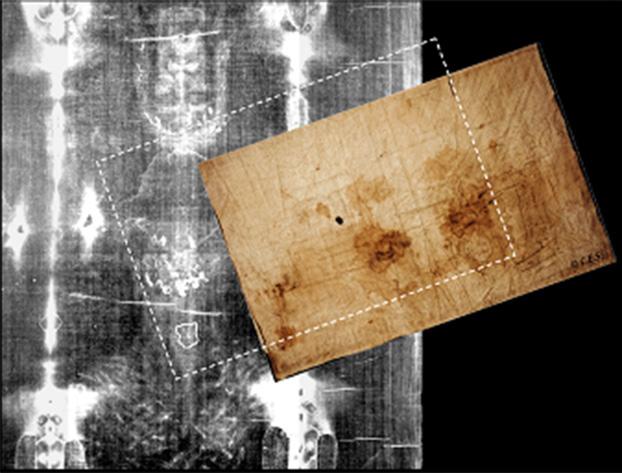
Spanish researchers have developed new insights into the mystery surrounding the burial of Jesus Christ. They suggest that the Sudarium of Oviedo and the Shroud of Turin both covered Jesus’ body after his crucifixion. These findings come from a detailed study published in the Journal of Cultural Heritage, led by the University of Oviedo.
The Sudarium of Oviedo
The Sudarium of Oviedo measures 33 by 21 inches and is traditionally regarded as the face cloth mentioned in the Gospel account of Jesus’ empty tomb. Researchers carried out simulations using a model head covered in linen, dressings, and artificial blood at body temperature. Their experiments showed that altering the head’s position produced bloodstain patterns similar to those found on the Sudarium. This supports the idea that body fluids accumulated in different regions due to the head’s position and the pressure of bandages.
A comprehensive examination of the original Sudarium was conducted. Techniques such as 3D scanning and X-rays confirmed that the wrinkles on the cloth were consistent with it being secured to the head by bandages or similar materials. According to study lead author Pedro Peinado, the evidence aligns with their hypothesis.
Comparisons with the Shroud of Turin
Peinado is also investigating connections between the markings on the Sudarium and those on the Shroud of Turin. The Shroud, an approximately 14.44-by-3.61-foot linen garment, is believed to have wrapped Jesus’ body after the crucifixion. It displays both front and back images of a man’s body.
The preliminary analysis indicates that the Sudarium’s stain patterns match wounds depicted on the Shroud, particularly around the forehead and back of the head. Discrepancies could be attributed to changes in the body’s position when each cloth was applied.
Peinado proposes a scenario in which the deceased was first upright, then tilted while wrapped with the Sudarium, before being laid face-up under the Shroud. He emphasizes that although each piece of evidence could be debated separately, together they offer a strong case that the same person was covered by both cloths.
Challenges in Dating the Artifacts
One major obstacle remains. Radiocarbon testing in 1988 dated the Shroud of Turin to between 1260 and 1390 AD, while evidence for the Sudarium places it as far back as the 8th century. Both dates fall long after Jesus’ time.
Past research has identified limestone deposits on the Sudarium similar to those on the Shroud, with a chemical composition resembling Jerusalem rock. However, the origin of the dust and its connection to a single person isn’t confirmed.
Even if Peinado’s analysis proves the artifacts covered the same individual, it doesn’t conclusively identify that person as Jesus. Nevertheless, Peinado argues that the injuries, first-century Jewish burial practices, and the Gospel account strongly support Jesus as the owner of the body covered by both cloths.
Peinado’s theory goes beyond traditional beliefs. Some theologians, such as Bible scholar Jeremiah Johnston, claim that the Shroud shows no signs of being physically unwrapped. This suggests Jesus’ body may have disappeared differently, contributing to Peinado’s confidence in his hypothesis.
 Uncovering Mysteries at Westminster Abbey and Beyond
 Global Events and Key Developments
 Human Lifestyles Impact Dogs’ Gut Health
 Underwater Encounter with Deep-Sea Giant
 Researcher Claims Discovery of Ancient Wood Aligns with Noah’s Ark Timeline
 BepiColombo Mission: Reaching Mercury and Unveiling Mysteries