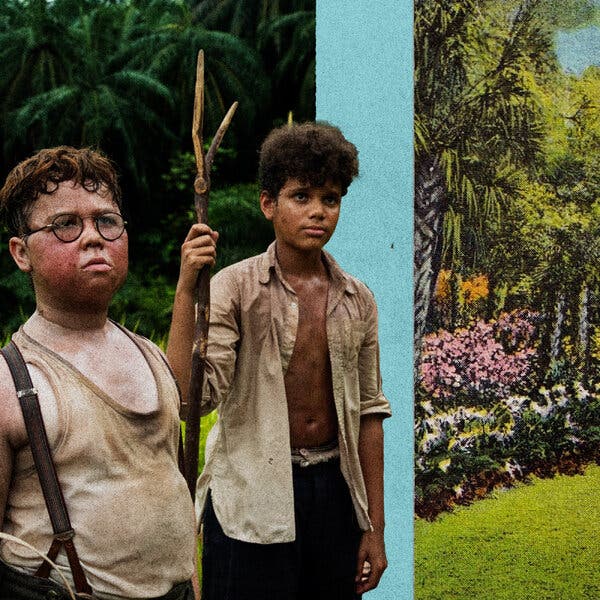
In my school days, William Golding’s “Lord of the Flies” was an essential read, nearly unavoidable as a rite of passage. Although it remains available, driven by its Nobel Prize legacy as much as by its brevity, the impact of Golding’s island has diminished over time.
Novels from the 1950s haven’t all aged gracefully, especially in today’s fast-paced world. The dystopian view of human brutality in “Lord of the Flies” might have been intense in its time (1954). However, in today’s context of school shootings and rising teen suicide rates, the story of Piggy and his friends can seem outdated, too simplistic, and lacking urgency. This is especially true for those raised on modern narratives like “The Chocolate War,” “The Hunger Games,” or Japanese works such as “Battle Royale” or “The Drifting Classroom.” The portrayal of savagery in Golding’s work doesn’t resonate as it did before.
In this climate of change, Jack Thorne’s adaptation of “Lord of the Flies” for Netflix emerges. This makes one wonder if Golding’s original theme—symbolized by the severed pig head on a stick—has any relevance today.
The novel’s depiction of savagery has been outpaced by modern interpretations, leaving “Lord of the Flies” pared down to its minimal characters. Moreover, its astounding success proved a double-edged sword. The novel has significantly influenced countless modern stories, from novels to graphic novels and video games. This influence, instead of inducing anxiety, has encouraged a hunger for more, making it challenging for the original text to captivate a contemporary audience that is familiar with its themes.
Even if not everyone has read “Lord of the Flies,” many have experienced its core themes and mythos in some form. Its ideas have become integral to our culture, surfacing repeatedly in a myriad of media including graphic novels like “Plutona,” video games like “DayZ,” and television series such as “The 100” and “Yellowjackets.” “Lord of the Flies” has even seeped into Stephen King’s works, from “The Long Walk” to the fictional town of Castle Rock in several of his novels.
 The TV President’s Image Without Network Footage
  Exploring Recommended Reads from Diverse Authors
  Maher Criticizes Far-Left Over Mask Policy Backlash
  Sydney Sweeney Criticized for Provocative Sports Ad
  Digital Divide: America’s Two Economies
  Trump Bans Certain Media Outlets from White House Access