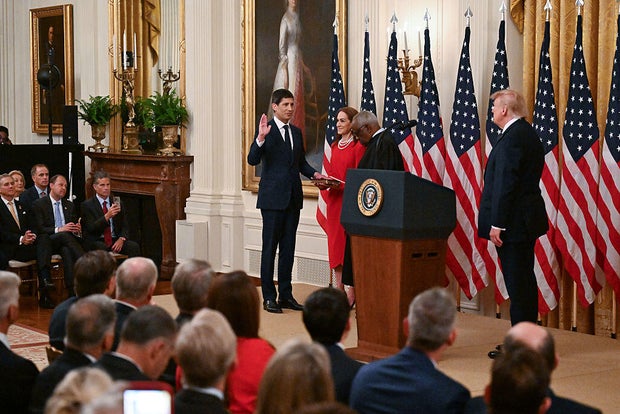
Washington—Kevin Warsh assumed the role of Federal Reserve Chairman on Friday, succeeding Jerome Powell. The swearing-in ceremony took place at the White House.
Warsh stated, “With this oath, I’ve accepted a high and solemn responsibility. Our mandate at the Fed is to promote price stability and maximum employment. Pursuing these aims with wisdom and clarity can result in lower inflation, stronger growth, higher real take-home pay, and a more prosperous and secure America.”
He emphasized a reform-oriented approach, learning from past experiences and maintaining integrity. President Trump introduced Warsh, surrounded by Supreme Court justices, Congress members, Cabinet officials, and business leaders. Justice Clarence Thomas administered the oath, with Warsh’s wife holding a Bible.
President Trump expressed his desire for Warsh to be independent, stating, “I want him to be independent and just do a great job. Don’t look at me, don’t look at anybody, just do your own thing and do a great job.” He praised Warsh as a potentially great chairman, respected by many, with unique abilities.
Trump had previously criticized the Fed and Powell over interest rates. While he didn’t explicitly call for lower rates on Friday, he encouraged prioritizing economic growth, saying, “We want to stop inflation, but we don’t want to stop greatness.” Trump’s past criticisms of Powell included harsh terms and an expressed interest in firing him at one point.
Warsh assured the Fed’s independence in monetary policy and mentioned a potential collaboration with the Treasury Department. However, monetary policy decisions involve a committee, making consensus essential for major changes like rate cuts.
The economic landscape poses challenges, with inflation exceeding the Fed’s 2% target and tensions from the Iran war. Some favor rate cuts due to labor market concerns, yet committee members are divided. Recent meetings kept rates stable, though a few members challenged the idea of hinting at rate cuts.
Financial markets share skepticism about near-term rate cuts. Projections suggest a majority believe rates will remain stable or increase by year’s end. Powell remains on the Fed Board, adding another influential voice to rate-setting discussions.
Historically, Warsh favored tighter monetary policy but recently advocated for lower rates. He suggests artificial intelligence may help lower inflation and increase productivity, potentially supporting a more flexible approach. This perspective could lead to discussions about technology’s economic impact.
Randall Kroszner, a former colleague, noted Warsh’s strategic thinking, emphasizing the need for consensus building. His approach favors long-term strategies over short-term political pressures.
This article includes contributions from Kathryn Watson.