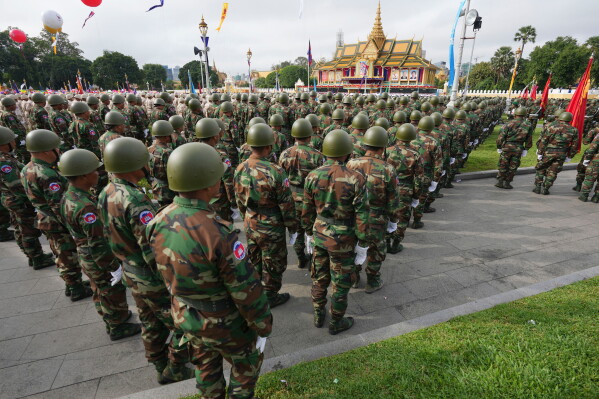
Family members often grip dog tags as if they still hold the hands of their lost loved ones. Companions-in-arms sometimes break down reading them. More than a century after a U.S. Army chaplain advocated for dog tags to be standard issue, these tags remain a potent symbol for grieving families.
Air Force Chaplain and Maj. Benjamin Quintanilla Jr., stationed at Dover Air Force Base, observes that these families seek connection. Dog tags become a sacred emblem in their search for that connection. From the World Wars to Vietnam and the Middle East conflicts, these military identification tags symbolize the sacrifice of American troops in global conflicts.
The Pentagon notes that the origin of the term ‘dog tags’ is unclear. The necessity to identify fallen soldiers became prominent during the American Civil War. Many soldiers, like the 75% of the 17,000 Union troops at Vicksburg National Cemetery, were buried as unknowns.
At the end of the Spanish-American War in 1898, Chaplain Charles C. Pierce, managing a morgue in the Philippines, requested tags for Army soldiers. By World War I, all combat soldiers wore them, becoming part of the official uniform by World War II. For example, a U.S. soldier from the 82nd Airborne Division held the dog tag of Cpt. Davis Boris during a memorial at Forward Operating Base Bermel in Afghanistan in 2007.
Today, advances in forensic science have made dog tags less vital for identification purposes, but they remain useful on battlefields. The religious affiliation listed on them guides chaplains in offering appropriate prayers. Yet, the profound symbolism and connection they represent make them invaluable.
Surviving family members deeply cherish the dog tags once worn by their loved ones. Even at dignified transfer ceremonies, new tags placed on caskets hold immense sentimental value. Some families continue to wear these tags or memorialize them with tattoos.
For military personnel, dog tags signify belonging. Quintanilla remarked, ‘I can trust somebody wearing the same identification as me. It signifies that I was part of something greater than myself.’
This topic is part of an ‘American Objects’ series, celebrating the 250th anniversary of the United States.
Associated Press religion coverage receives support through AP’s collaboration with The Conversation US, funded by Lilly Endowment Inc. AP takes sole responsibility for this content.
 The Unlikely Intrigue of a 1990 NBA Trading Card
  Celebrating Day of the Dead: Students Craft Calaveras in Pilsen
  Family Conflict over Sentimental Necklace
  Cindy Crawford’s Son Presley Gerber Dies at 27
  Navy Veteran Generald Wilson Reflects on Emotional National Anthem Performance
  Fat Bear Week: A Unique Annual Tradition at Katmai National Park