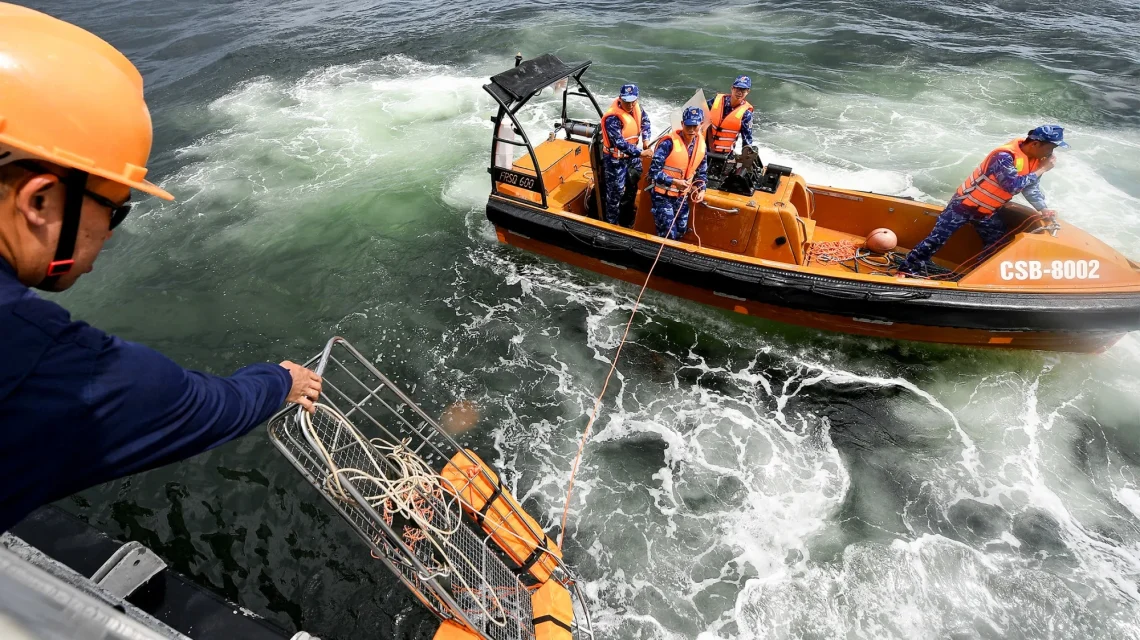
On October 31, 2022, a Chinese Coast Guard ship, one of the largest in the fleet, left Sanya in southern China. It started patrolling the contested northern Spratly Islands. Five months later, it shifted course towards Vietnamese-occupied areas. The global spotlight hit the ship when the Philippines accused it of firing a military-grade laser at a nearby resupply vessel. By 2025’s end, the ship neared nearly 30 features within 10 nautical miles in the South China Sea, claimed by multiple countries. This ship symbolizes China’s expanding maritime presence, with increased Coast Guard and militia operations asserting territorial claims. Neighboring nations are responding in kind, with Vietnam at the forefront, strengthening its outposts and international coordination.
Sources: Starboard Maritime Intelligence, British Oceanographic Data Centre, Asia Maritime Transparency Initiative
As tensions rise with the ongoing conflict in Iran, the US showcased military exercises in Asia, aiming to deter China, especially around Taiwan and the South China Sea. Yet, the risk of confrontation between China and Vietnam grows. The Spratly Islands are the focus, with Vietnam mirroring China’s strategy by building and fortifying its own artificial islands. Bloomberg News’s analysis of tracking data identified over 100 Chinese vessels close to Vietnamese-controlled features between May 2022 and April 2023, nearly twice the number from the prior year. Their activity focused on Sand Cay, Namyit Island, and Petley Reef, which received significant upgrades.
Increased Chinese Presence
By UN standards, nations may assert territorial seas up to 12 nautical miles from land features like reefs and islands. Ship tracking shows China’s presence near Vietnamese features has surged, reflecting Vietnam’s growing resistance. Vietnam balances relations between superpowers, especially with the Middle East conflict affecting fuel supplies. The US’s perceived instability adds to these concerns. Despite competing territorial claims, Southeast Asian nations, including Vietnam, are uniting to limit Beijing’s maritime influence.
“The strategy aims to enhance Vietnam’s deterrence capabilities, deploying forces effectively against Chinese tactics,” Nguyen The Phuong, University of New South Wales, noted.
Philippine and Vietnamese forces have increased cooperation through joint maritime exercises. The fortified islands in Vietnam straddle crucial trade corridors. The South China Sea is vital for global trade, estimated at $4 trillion annually, presenting both economic opportunities and risks.
Shifting Regional Dynamics
With the global energy market impacted by the conflict in the Strait of Hormuz, more pressure is on Southeast Asian nations to foster better relations with China. Despite efforts to stabilize the region, data shows rising risks of conflict over the South China Sea. Notably, Chinese and Vietnamese tensions are escalating. The Philippine Defence Secretary emphasized a cooperative relationship with Vietnam, contrasting China’s aggressive approach.
Recent diplomatic and military coordination between Vietnam, the Philippines, Taiwan, Indonesia, and Malaysia highlights a shift towards regional security collaboration. Vietnam upgraded its ties with the US, marking a departure from past animosities. This cooperation includes receiving US patrol boats.
President To Lam, leading Vietnam’s Communist Party, advocates for a stronger military by 2030 despite budget constraints. Vietnam’s defense spending is modest compared to China’s. Yet, military expansions among regional powers are expected, with significant financial commitments through 2030.
Potential Conflict and Cooperation
Vietnam has faced maritime disputes with China for years. A 2014 standoff over a Chinese oil rig ramped up tensions during Beijing’s initial constructions on artificial islands. Vietnam responded by initiating its own territorial developments. These strategic expansions have accelerated in recent years.
China continues to assert claims over the South China Sea based on the nine-dash line, disputed by regional nations and dismissed legally. Chinese activities reinforce their presence with military infrastructure built on their islands. Vietnam’s island development lags behind China’s but remains noteworthy.
Fishing communities in Vietnam feel the impact of increased tensions, reporting rising incidents with Chinese vessels. The fishing industry, a vital economic sector, is forced to adapt, with local authorities advising caution and support systems.
“People are resolved to fish but are worried,” says Huynh Van Dam from Quang Ngai.
The ever-complex geopolitical landscape in the South China Sea continues to evolve, highlighting the region’s strategic importance and the challenges faced by those living and working within the disputed waters.
 Irish Crime Leader Extradited to Face Charges
  Massie Criticizes Iran Conflict as Trump’s Major Blunder
  Netanyahu Rejects U.S. 15-Point Plan for Gaza
  Sailor’s Bold Arctic Adventure for Science and Exploration
  New Trilateral Defense Agreement Explained
  Israel’s Ongoing Strikes in Gaza Despite Ceasefire Agreement