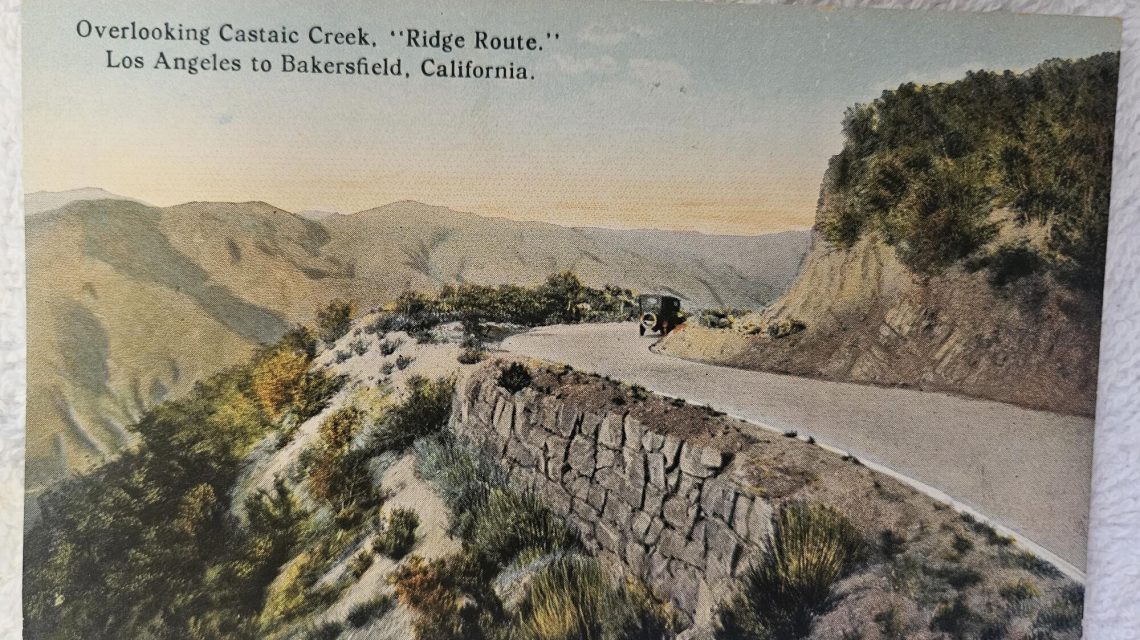
The history of Interstate 5 is more than just a tale of travel. Before its completion in 1970, Californians used the Ridge Route to connect Southern and Central California. These areas are so distinct that discussions of separating them continue today.
The Early Years: Ridge Route’s Origins
Before I-5, two versions of the Ridge Route existed. The original stretch of road, finished in 1915, featured 697 curves over its 36 miles. That’s roughly 20 hairpin turns per mile. Speed limits capped at 15 mph, making it a thrilling yet daunting passage.
Early travelers included trucks, tourists, and locals. On this treacherous route, steep inclines and unpredictable weather made driving a nerve-wracking ordeal. Today, only a portion remains accessible, mostly to local traffic and vintage car enthusiasts.
“About 18 miles of it is on the National Register of Historic Places,” a note worth recalling before hitting the gas.
Native Roots and Spanish Influence
Travel through the Tejon Pass began with Native Americans, who settled there long before Spanish soldiers ventured north in the 1770s. The name ‘Castaic’ comes from the Chumash language, meaning “the eye.” Spanish explorers named the area ‘Canada de las Uvas’ for the wild grapes flourishing there. Unfortunately, the less romantic name Tejon Pass comes from the Spanish word for ‘badger.’
The Ridge Route: A Road of Innovation
The road’s steep passages were initially traversed by packs of mules and horses. Visionary Californians of the mid-1800s, including Phineas Banning and Andres Pico, helped blaze an easier path. By 1858, the Butterfield stagecoach carried mail over a treacherously steep passage.
Edward Beale later took over to cut deeper into the rugged mountains. The outcome, known as Beale’s Cut, charged tolls and gave the road a more accessible form.
The Automobile Age
In 1902, the first automobile, an Autocar, made its way through Beale’s Cut. When this car stalled on an incline, the driver, Ralph Hamlin, reversed uphill, owing to fuel delivery issues from a rear-mounted tank.
Time eroded Beale’s Cut, but it appears in classics like John Ford’s “Stagecoach.” Over time, this narrow route with its daunting inclines gave way to even larger projects to accommodate future demands.
Increased Accessibility and the Role of the Army
Constructed in 1910, the Newhall Tunnel offered a safer alternative to Beale’s Cut. But the Ridge Route remained a groundbreaking project—with nearly 700 curves carved through rugged mountainsides by hardworking mules and horses.
Road crews lived alongside the construction, establishing vital services like hotels and repair garages. These spots became refuges when weather made travel impossible.
Challenges and Crime Along the Way
Death and danger haunted the old Ridge Route. Accidents and robberies were common. In 1931, a tragic car accident left a woman in a ravine for 50 hours, cradling her dying daughter. Robberies were rampant due to slow-moving vehicles on laden roads without lamps.
December 1923 saw 20 cars robbed in one night, making travel perilous.
The Legacy of the Ridge Route
The nostalgia of these roads lingers due to the efforts of the Ridge Route Preservation Organization. Volunteers dedicate their time to preserving nearly 18 miles of this national historic treasure.
The evolution of the Ridge Route culminated in the ‘new’ Ridge Route, launched in 1933, offering wider lanes and straighter paths. Economic needs resulted in constant upgrades until Interstate 5 ultimately outpaced it.
Parts of the road are now submerged below Pyramid Lake, while others face natural threats. Yet, the Ridge Route holds heavy memories for many today.
The road once connected by Highway 99 became a mythic path for John Steinbeck’s Joad family in “The Grapes of Wrath.” Their journey ended in California as they peered upon a hopeful future.
 Discover Five Simple Art Projects to Try at Home
  Chicagohenge: When Sunlight Aligns with City Streets
  Navy Veteran Generald Wilson Reflects on Emotional National Anthem Performance
  Lucas Museum of Narrative Art: A New Cultural Landmark
  Northlight Theatre’s ‘The Front Page’: A Satirical Nod to Chicago’s Journalistic Past
  The Value of Unsupervised Play in Child Development