Archaeologists in the United Kingdom have discovered an ancient Roman villa, over 1,600 years old, located between the villages of Halberton and Sampford Peverell in Devon. This fourth-century site was excavated under the Saving Halberton’s Ancient Roman Environment (SHARE) project, a collaborative effort between the University of Exeter and Cotswold Archaeology, as reported by SWNS.
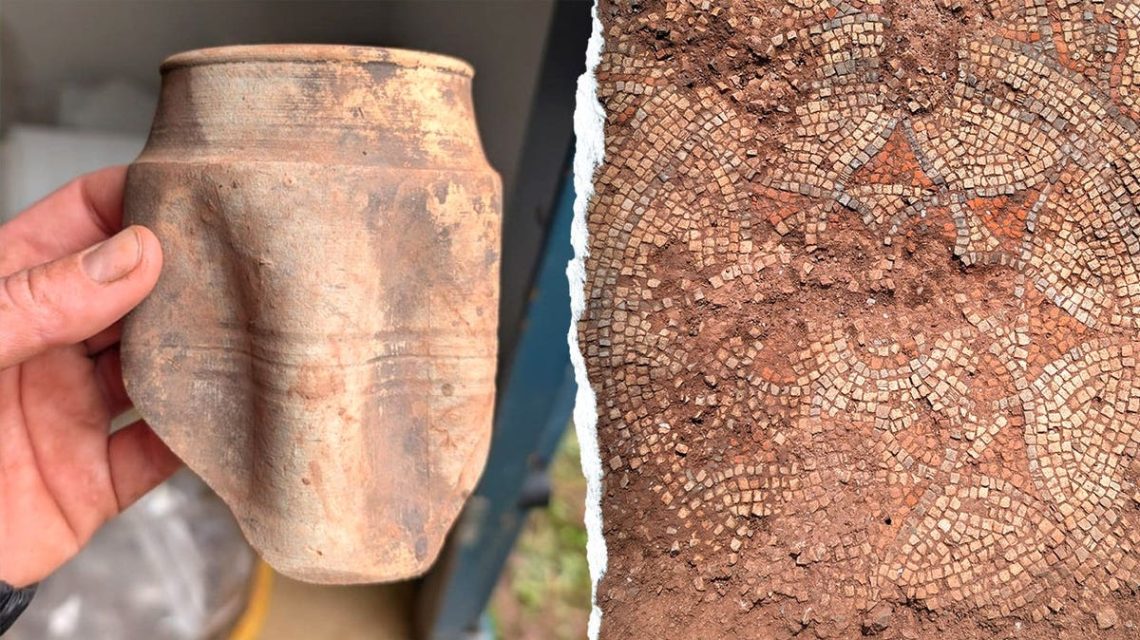
The prominent feature of this excavation is a detailed Roman mosaic, crafted from thousands of tiny stone cubes arranged in a floral design. Bill Horner, county archaeologist and historic environment manager at Devon County Council, remarked, “The polychrome mosaic is the most westerly example to have been found in a villa in Roman Britain.” This mosaic is part of the remains that suggest extensive Roman influence and affluence in the area.
Photos released from the site include images of the mosaic, ancient pottery, and other artifacts previously buried for centuries. The red, white, and dark blue cubes of the mosaic form a stylized flower with eight overlapping petals.
Alongside the villa, two additional stone buildings were uncovered. One likely served as a bathhouse, while the other was used for agriculture. Archaeological findings also include a delicate copper-alloy bracelet, a fine silver-plated spoon, a beaker for drinks, pottery fragments, and a gemstone engraved with the goddess Victory.
Britain was part of the Roman Empire from A.D. 43 until the early fifth century, and this colorful mosaic is considered the westernmost example found at a Roman villa in Britain. The villa appears to have been home to a prosperous Roman family.
Susan Greaney, the project leader and an archaeology professor at the University of Exeter, expressed surprise at finding such an elaborate bathhouse. She commented, “At the outset, we knew this villa and its surrounding working areas was an important site for understanding the Romanization of Devon.” Greaney highlighted the villa’s significance, emphasizing that it was a residence for individuals of wealth and high status.
The villa site was initially discovered in 2004 by John Hill, a local metal detectorist who uncovered Roman remains. Current efforts focus on safely transporting the mosaic to the Tiverton Museum of Mid-Devon Life.
This significant find is among several notable Roman discoveries in England. Last summer, archaeologists unearthed a 2,000-year-old Roman settlement in the Cotswolds following a chance discovery by an amateur metal detectorist. More recently, archaeologists discovered a rare Roman coin and other artifacts in preparation for a British railway project.
 The Discovery of Incendiamoeba cascadensis: A Fire Amoeba
  Archaeological Discovery in Germany: Largest Hoard of Roman Coins Found
  Hurricane Formation and Strengthening
  Ancient Mastodon Tooth Unearthed in California Creek
  The Tiny World of the Pumpkin Toadlet
  Chimps and Self-Medication: Insights from Gombe Stream