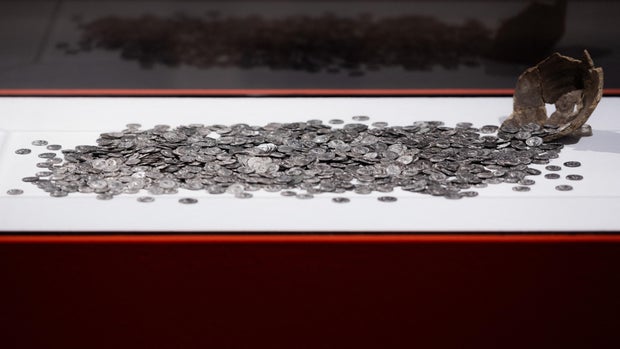
On September 22, 2026, amateur archaeologist Oliver Riedl made a significant discovery in western Germany. While using a metal detector in a field near Wesseling, south of Cologne, he found several Roman silver coins. The persistent beeping of his detector indicated a larger find. Contacting local authorities led to the unearthing of 934 Roman silver denarii, the largest collection from Roman Emperor Hadrian’s era ever discovered in Germany. This was confirmed by the local office for archaeological monuments.
Riedl knew that something substantial was buried as his detector kept signaling even after discovering the initial coins. These coins, totaling 3.1 kilograms (6.8 pounds), are now displayed at the LVR-LandesMuseum Bonn. Most coins are from the Flavian emperors’ time (A.D. 69–96), with the oldest minted in 148 B.C., according to a museum release.
The LVR Office for the Preservation of Archaeological Monuments in the Rhineland suggests that the coins were deliberately buried in the second quarter of the second century A.D. Erich Classen, the state archaeologist and director of the office, speculated that the coins were hidden for safekeeping, given the absence of banks in that era. The reason for the treasure’s non-recovery remains unknown, but Classen suggested the owner might have died before reclaiming it.
“We can only speculate about the motives, but it’s very likely that someone wanted to keep this money safe,” said Classen.
Finds like this are not unique, yet few second-century discoveries match the extent of the Wesseling hoard. The value of these coins at the time is difficult to determine, but Roman legionary pay provides a reference point. Rahel Otte, a research associate at the archaeological office, explained that legionaries earned 300 denarii per year, with half allocated for essentials. A legionary would need over six years of savings to amass the Wesseling treasure.
The region near Cologne was under Roman control from 39 B.C. to A.D. 459, initially established by General Marcus Vipsanius Agrippa to fortify the Rhine River border. This outpost evolved into Colonia Agrippina, today’s Cologne.
Recent years have seen other Roman-era discoveries across Europe. In February, metal detectorists uncovered two Roman-era lead ingots in Wales. In 2024, construction in central England revealed a Roman coin hoard valued over $125,000. Polish detectorists also discovered a large cache of ancient Roman coins, and ancient silver coins surfaced on a Mediterranean island.
 The Discovery of Incendiamoeba cascadensis: A Fire Amoeba
  Hurricane Formation and Strengthening
  Ancient Mastodon Tooth Unearthed in California Creek
  The Tiny World of the Pumpkin Toadlet
  Chimps and Self-Medication: Insights from Gombe Stream
  Rovelli Challenges Physics with Relational View