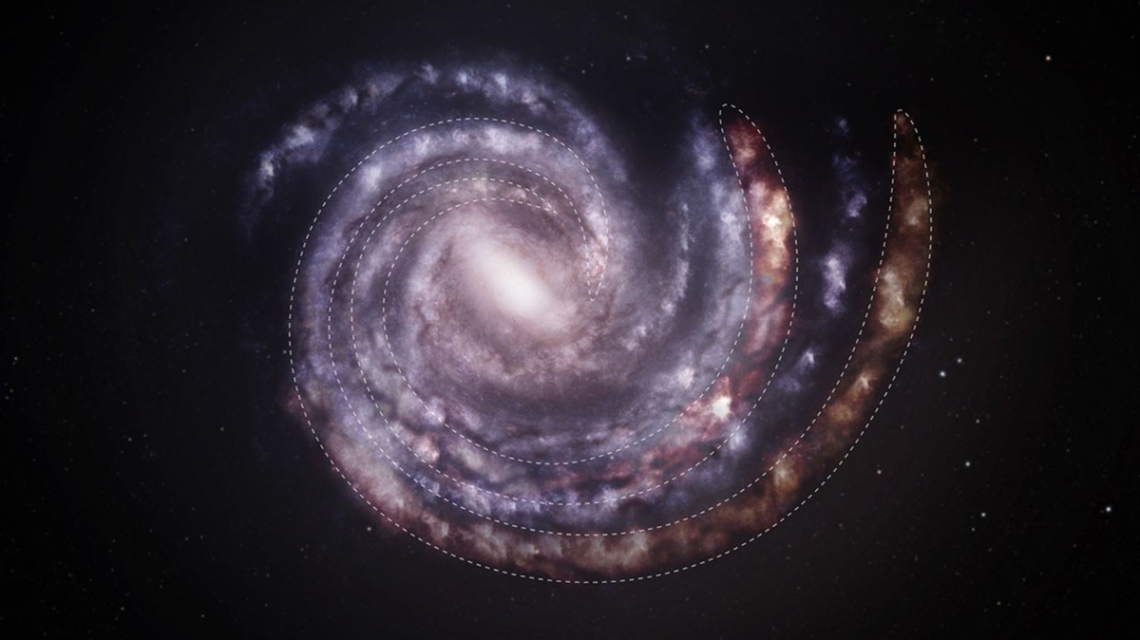
Astronomical Discovery Extends Milky Way’s Spiral Arms
Recent findings by astronomers indicate that the spiral arms of the Milky Way stretch further into space than previously understood. Utilizing precise distance measurements of dust clouds within these arms, scientists utilized data from NASA’s Chandra and the European Space Agency’s XMM-Newton telescopes, both positioned in orbit.
These researchers employed gamma-ray bursts from distant galaxies. As X-rays from these bursts traveled through the Milky Way, they interacted with dust clouds, producing measurable rings. This approach allows for accurate distance measurement using simple geometry.
PhD student Beatrice Vaia, who led the study, stated, “This method bypasses assumptions about the Milky Way’s rotation, resulting in less uncertainty when measuring the outer regions of our galaxy.” Data revealed that dust clouds in the most distant spiral arms are approximately 3,500 light-years wide.
Understanding the Galaxy’s Structure
Though astronomers have known about the Milky Way’s spiral arms for around a century, mapping them has been challenging due to Earth’s location within the arms. This new technique surpasses limitations imposed by our position in the galaxy, offering new insights into its structure.
Co-author Ilaria Fornasiero highlighted the importance of accurate distance measurements, stating that these revisions could impact our understanding of the galaxy’s mass and dimensions.
A potential drawback is the rarity of suitable gamma-ray bursts. Over 25 years, researchers have identified only a few bursts bright and well-positioned enough for effective measurements. “We will persist in seeking more opportunities,” stated co-author Andrea Tiengo.
Such advancements offer fresh perspectives on our cosmic neighborhood.
 Hurricane Formation and Strengthening
  Ancient Mastodon Tooth Unearthed in California Creek
  The Tiny World of the Pumpkin Toadlet
  Chimps and Self-Medication: Insights from Gombe Stream
  Rovelli Challenges Physics with Relational View
  Legal Waiver for Sharing UAP Information Announced