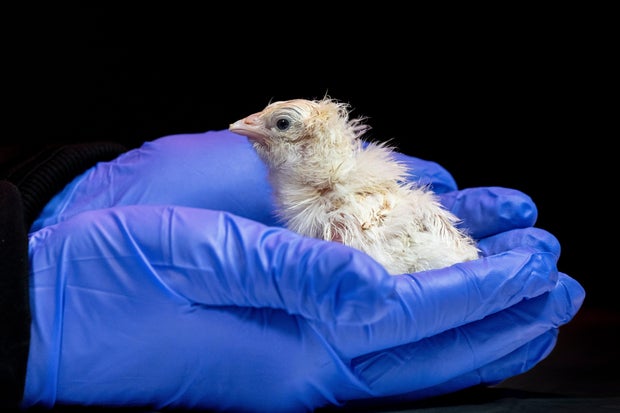
On Tuesday, a biotech company announced a significant breakthrough in artificial incubation, sparking mixed reactions among scientists. Colossal Biosciences revealed it had successfully hatched live chicks in an artificial environment. This latest development highlights the company’s commitment to its controversial de-extinction mission.
Chicks Hatched from Artificial Eggs
Colossal Biosciences reported the birth of twenty-six baby chickens, ranging from a few days to several months old, from a 3D-printed structure that mimics a natural eggshell. The CEO, Ben Lamm, stated this technology might eventually allow for the genetic modification of birds to resemble New Zealand’s extinct South Island giant moa, whose eggs are 80 times the size of a chicken’s and challenging for any current bird to lay.
Lamm explained their goal was to enhance nature’s design, making it more efficient and scalable.
The company shared images and videos depicting scientists handling the chicks with care. Despite these advancements, some independent scientists argue the technology lacks crucial components to be a true artificial egg, and question its potential role in reviving extinct species.
Scientific Skepticism and Challenges
Evolutionary biologist Vincent Lynch from the University at Buffalo expressed doubts about the feasibility of resurrecting extinct beasts. He explained that the technology might produce genetically modified birds but not recreate the extinct moa.
“They might be able to use this technology to help them make a genetically modified bird, but that’s just a genetically modified bird. It’s not a moa,” stated Vincent Lynch.
To hatch the chicks, Colossal scientists poured fertilized eggs into the system and placed them in an incubator, adding calcium usually absorbed from the eggshell. They monitored embryo development and growth in real-time.
The artificial eggshell allows oxygen to penetrate, similar to a natural egg. However, other key elements, such as temporary organs that nurture and stabilize the chick, were not included.
Lynch noted, “That’s not an artificial egg because you’ve poured in all the other parts that make it an egg. It’s an artificial eggshell.”
Earlier research utilized rudimentary technology for creating transparent eggshells for chick development. Such methods advance understanding of development processes applicable even to mammals and humans.
Future Prospects and Bioethical Concerns
Colossal aims for moa resurrection but acknowledges many steps remain. They need to compare ancient DNA from preserved moa bones with living bird genomes and develop larger eggshells.
Bioethicist Arthur Caplan from New York University raises questions about environmental suitability if they succeed.
“The big challenge is, what environment is this animal going to live in?” Caplan asked.
Nicola Hemmings, a reproductive biology expert, suggests such techniques might better preserve endangered species rather than resurrect extinct ones.
“My personal interests lie more in preserving what we’ve got than trying to bring back what is already gone,” stated Hemmings.
Broader Implications for Bird Species
Colossal emphasized their technology’s role beyond de-extinction. It seeks to help rescue vulnerable bird embryos, facilitate breeding in captivity, and potentially revive species from frozen cells and DNA.
The company previously gained attention in 2021 for plans to revive the woolly mammoth and dodo bird, followed by breakthroughs in reviving the extinct Tasmanian tiger in 2024.
During a 2023 interview, CBS News correspondent Jonathan Vigliotti remarked on the ambitious nature of Colossal’s plans.
“I hear mammoth and dodo in the same sentence and, you know, it’s science fiction to me.”
Lamm acknowledged the perception, noting, “Yeah, I mean, it is, until it’s not.”
 President Trump Proposes ‘Super Intelligence’ as New AI Term
  First Lady Melania Trump’s AI Education Push Amid Concerns
  Expansion of Data Centers Fueled by AI Development
  Beijing’s Tactical Undermining of U.S. Supremacy Through AI
  The Discovery of Incendiamoeba cascadensis: A Fire Amoeba
  Controversy Surrounds Automated License Plate Readers Across the U.S.