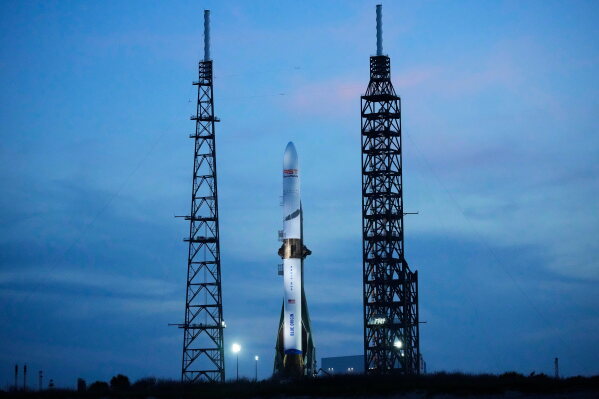
Jeff Bezos’ aerospace company, Blue Origin, is currently evaluating the damage to its launch pad after a New Glenn rocket exploded during a test firing. The explosion resulted in a significant orange fireball that was visible and audible for miles around Cape Canaveral, Florida.
The massive New Glenn rocket, standing at 321 feet (98 meters), was scheduled for a brief engine ignition on Thursday night, ahead of its satellite launch planned for the following week. However, the rocket burst into flames, destroying part of the launch pad.
Local emergency officials have issued warnings, advising the public to steer clear of any debris that may wash ashore and to report it to 911 instead.
Named in honor of John Glenn, the first American to orbit Earth, the New Glenn rocket is crucial for Blue Origin’s plans to deliver landers to the moon. This mission is part of NASA’s Artemis program, which aims to establish a base near the moon’s south pole. The program’s goal includes landing the first Artemis moonwalkers by 2028. Earlier this week, NASA awarded Blue Origin a new contract worth hundreds of millions of dollars.
None of the 48 Amazon Leo satellites, which are rivals to SpaceX’s Starlink for providing internet service in remote areas, were aboard during the explosion. Another batch of Amazon Leo satellites is set to launch from Cape Canaveral Space Force Station on a United Launch Alliance Atlas V rocket.
Within 12 hours of the New Glenn explosion, SpaceX successfully launched more Starlink satellites on Friday morning. SpaceX operates from two launch pads, one at the Space Force site and another at NASA’s Kennedy Space Center. Blue Origin has just one launch pad in Florida. Their smaller New Shepard rockets, which offer brief space trips for tourists and scientific experiments, are launched from Texas. These suborbital flights were paused in January to prioritize focus on New Glenn and upcoming lunar missions. This focus is now paused pending the outcome of the explosion investigation.
The Associated Press Health and Science Department is supported by the Howard Hughes Medical Institute’s Department of Science Education and the Robert Wood Johnson Foundation. The Associated Press holds sole responsibility for the content.
 NASA’s New Space Telescope Launch: A Breakthrough in Cosmic Exploration
  Trump’s Call with ISS Astronauts and Honors at NASA
  Anticipated Northern Lights Due to Solar Activity
  NASA’s Nancy Grace Roman Telescope Prepares for Launch
  Rare Deep Partial Lunar Eclipse Visible Across the U.S.
  China Delays Chang’e-7 Lunar Mission Plans