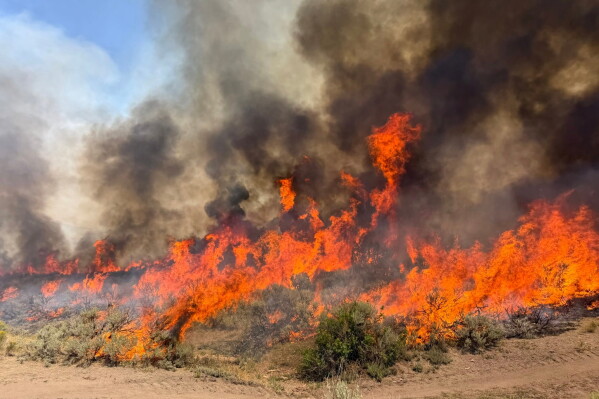
Vancouver, British Columbia (AP) — The province of British Columbia has declared a state of emergency in response to a fast-moving wildfire that has already devastated homes, trapped residents, and forced over 20,000 individuals to evacuate from communities along Okanagan Lake in western Canada.
Premier David Eby announced the emergency as the province faces over 100 active wildfires. Nearly half of these fires remain uncontrolled due to hot, windy conditions and ongoing drought.
The entire community of Summerland, which has around 12,000 residents, and approximately 8,000 people in and around nearby Peachland have been ordered to evacuate. Officials are still assessing the extent of damaged homes.
Some residents found themselves trapped and required rescue, according to Eby. Search-and-rescue teams continue to search behind the fire lines for individuals who might be stuck.
“Many families are experiencing an unimaginable day,” Eby commented. “People have lost their homes and many are displaced. Others await news about loved ones.”
Cliff Chapman, director of wildfire operations for the BC Wildfire Service, noted that helicopters were used to rescue people unable to escape via road. He emphasized that the situation could have been more dire without the collaboration of various agencies.
The Bald Range wildfire, initially reported on Friday evening, rapidly expanded to cover about 50 square kilometers (19 square miles) within hours. It swiftly overwhelmed Faulder and traversed the 15 kilometers (9 miles) to Summerland with alarming speed.
Chapman described wildfire conditions across British Columbia as “explosive” and warned that other communities might face similar threats. Kelly Greene, the province’s Emergency Management Minister, highlighted that the state of emergency grants additional powers, permitting travel restrictions and securing necessary accommodations for evacuees.
Erick Thompson, an emergency official from the Regional District of Okanagan-Similkameen, dubbed the wildfire as one of the “quickest-moving, fastest-growing” the region had ever encountered. He had to evacuate his family, leaving the emergency operations center.
“I had to leave the EOC to get my family to safety. We’re heading south,” he reported in a video from his car as traffic congested around him.
Social media videos showed homes ablaze as residents navigated roads flanked by flames.
Homeowner Kerry Gold and her husband, Mike Elsinga, escaped at about 12:30 a.m. after witnessing flames beyond nearby mountains.
“It’s frightening. It’s advancing quickly,” Gold described.
The couple, recent migrants from Vancouver, packed essentials, prepared their cat, and planned to aid a disabled friend in evacuating.
Elsinga stated, “You want to defend your home, but equally, you don’t want to be caught in the fire’s path.”
Canada has seen increasingly destructive wildfire seasons, leading to mass evacuations and spreading smoke across vast parts of both Canada and the United States.
 Remembering Chris Spatola: ESPN Analyst and Former Army Guard
  Controversy Surrounds Massachusetts’ Proposal for Nurse Home Visits
  Protests Emerge Following ICE Shooting of Venezuelan Man in Austin
  NYC Mayor Mamdani and President Trump Discuss Media Access and Criticism
  Presley Gerber, son of Cindy Crawford, passes away at 27
  Piers Morgan Challenges Earl Spencer’s Claims in Upcoming Memoir