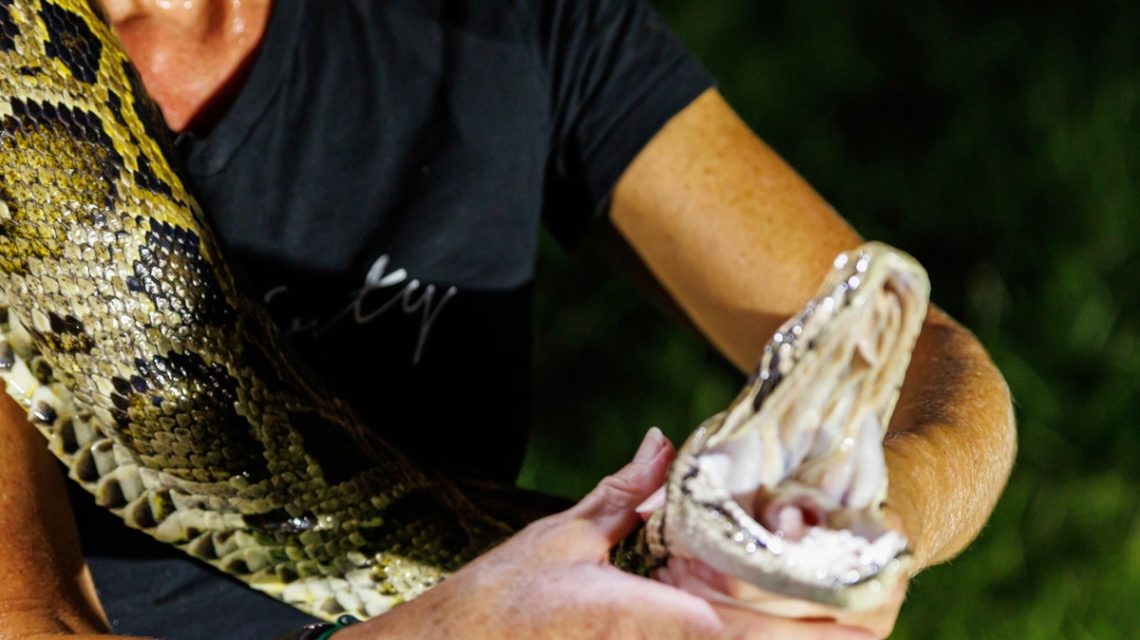
In Collier County, Florida, Burmese pythons pose a significant threat to the ecosystem. These snakes have disrupted the Everglades for over 25 years and are now moving farther north.
Initially, the cold was believed to limit their range to South Florida. However, the pythons have adapted by using burrows to survive lower temperatures. Amy Siewe, a professional python hunter and guide, notes that food availability drives their northward movement. She explains, “They’re using gopher tortoise and armadillo burrows to stay warm during cold Florida nights.”
Siewe left a 13-year real estate career in 2019 to tackle the python problem in Florida. With a background in snakes and reptiles, she is now fully dedicated to python hunting. These pythons consume 98% of the local mammal population in parts of the Everglades, severely affecting the ecosystem. Siewe warns of the long-term damage these snakes might cause.
“It’s crucial to remove them to protect native wildlife,” says Siewe.
Her husband, Dave, and their dog, Dixie, assist with the hunts, as highlighted by Fox News Multimedia Reporter Amy Galo during a search in Collier County. Dixie helps locate pythons, sitting to signal their presence, allowing Siewe to verify and capture them.
Siewe conducts these hunts several times a week and also leads guided hunts. The truck’s modified platform, known as the “snake deck,” gives her a better view to spot the elusive snakes amid dense grass and wetlands.
The python population in the Greater Everglades is estimated at tens of thousands, though their mastery of camouflage complicates an exact count. “They spend about 85% of their time hidden,” Siewe states, highlighting the challenge.
Over 23,000 pythons have been removed, per the Florida Fish and Wildlife Conservation Commission. Yet, sightings north suggest new population centers may exist, potentially disconnected from those in the Everglades.
“We see separate populations in Brevard and Charlotte County,” explains Siewe, theorizing these are not extensions of the well-established Everglades group.
Once established, eradication is challenging. Pythons reproduce prolifically, with large individuals potentially laying over 100 eggs annually. Siewe stresses the importance of early detection and public education to prevent further releases.
 Michigan’s Ypsilanti Township Residents Oppose University of Michigan’s New Research Center
 NOAA Signals Early End to 2026 Hurricane Season Amidst Strong El Niño
 Concerns Over Army’s Plan to Detonate Explosives in Iowa
 Concerns Over Army’s Planned Detonation of Lead Waste in Iowa
 Understanding the Insurance Dilemma in Fire-Prone Areas
 New York’s Nuclear Power Push: Challenges and Solutions