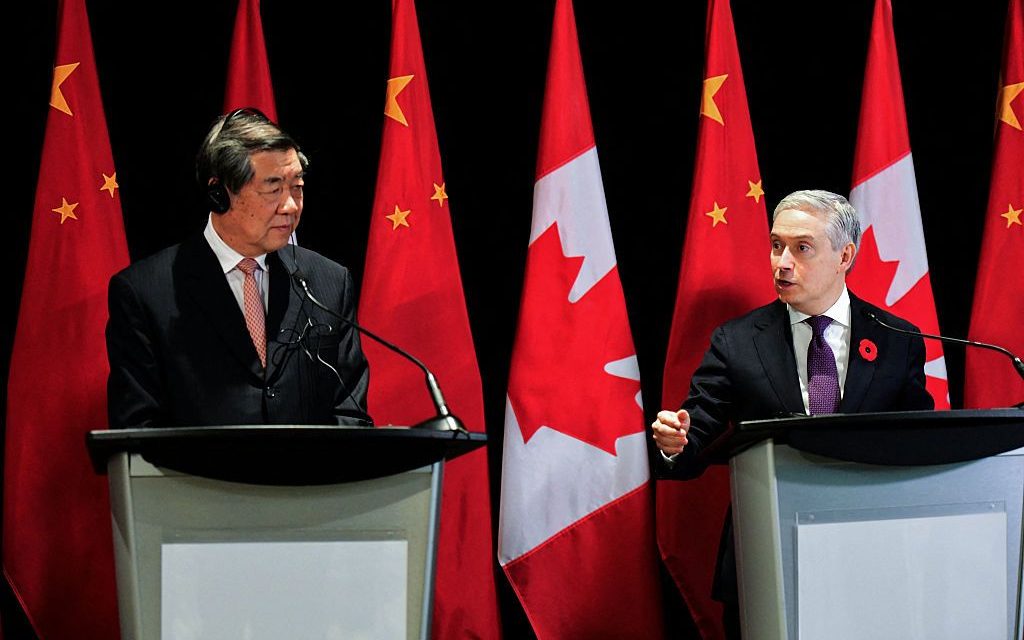
Canada has inked fresh economic deals with China. This move seeks to ease trade tensions with the United States. The agreements were announced after talks in Vancouver. These agreements aim to deepen financial cooperation between the two nations as Prime Minister Mark Carney readies for the Asia-Pacific Economic Cooperation (APEC) summit in Shenzhen.
Finance Minister François-Philippe Champagne and International Trade Minister Maninder Sidhu hosted China’s Vice-Premier He Lifeng in Vancouver for negotiations. Champagne remarked on the importance of open dialogue and economic cooperation between Canada and China. This includes expanding trade and investment opportunities while building a resilient economy.
Both countries have agreed to extend an existing trade deal until the end of 2028. China will maintain lower tariffs on Canadian products such as canola meal, peas, lobster, and crab. In return, Canada will continue allowing certain Chinese metal products to enter the country without extra tariffs. This deal targets helping Canadian agricultural and seafood businesses while offering Canadian companies access to vital Chinese metals.
Canada eyes diversified trade relations amidst ongoing tariff disputes with the U.S. Prime Minister Carney noted Washington’s withdrawal of a proposal requiring U.S. approval over Canadian trade agreements. President Trump has suggested a deal with Canada is near, but discrepancies remain.
The New Agreements
The discussions resulted in three agreements involving cooperation between finance ministries, financial regulators, and central banks of both countries. These arrangements aim to establish closer dialogue and facilitate cooperation in economic policy, and financial market access. A bilateral currency-swap arrangement is also in the works.
The discussions follow Carney’s trip to Beijing where he and President Xi Jinping renewed a strategic partnership. Expanding trade with other nations is part of Carney’s strategy to lessen Canada’s reliance on the United States.
Champagne highlighted the strategic nature of engaging with China, the world’s second-largest economy, despite recent political developments in Washington.
Impact on Canadian Exports
An extension builds on an earlier agreement, easing a trade dispute that impacted Canadian agricultural exports. Canada witnessed a significant rise in agricultural exports to China. Canola meal exports to China skyrocketed to $277 million, pea exports reached $245 million, and lobster exports increased 57% to $142 million.
China is Canada’s second-largest merchandise trading partner, with bilateral goods trade at $89 billion last year. According to Ottawa’s Department of Finance, Canadian exports to China grew 41% in 2026 compared to the same period last year. Carney’s administration aims to further increase exports by 50% by 2030.
Ongoing U.S. Trade Talks
Trade negotiations with Washington are in progress, though differences persist. Last week, the U.S. dropped a demand for final approval over Canada’s trade agreements. The remaining tariffs on lumber, steel, aluminum, and automobiles continue to strain relations.
Foreign Minister Anita Anand hopes for progress following Republican losses in elections. Canada faces job losses in affected sectors and seeks to ease trade tensions.
Anand emphasized the strategic work Canada is doing to double non-U.S. trade within the next decade. Canada remains the only G7 nation with a free trade agreement with all other G7 members.
Changes in Tariffs on U.S. Goods
Canada announced changes to tariffs on American goods. The tariff relief program is extended until mid-2028. This exempts certain U.S. imports, crucial for industries like mining and oil extraction, from tariffs. However, some exemptions will be retracted by February 2027 for products that have Canadian alternatives.
Between March 2025 and October 2026, Canada assessed $10 billion in tariffs on American goods, with $6.3 billion relieved or omitted. Trade Minister Dominic LeBlanc emphasized the balance between supporting Canadian businesses while promoting domestic production.
 Military Court in Congo Sentences 66 Soldiers to Death
 Nvidia CEO Faces Scrutiny Amid U.S.-China Tensions
 President Trump Discusses Immigration, Deportation, and International Relations
 US and Russia Tensions Over Ukraine Conflict
 Analysis of the French Presidential Race and Economic Concerns
 Alleged Chinese Spy Alice Huang and Her Influence on Nvidia