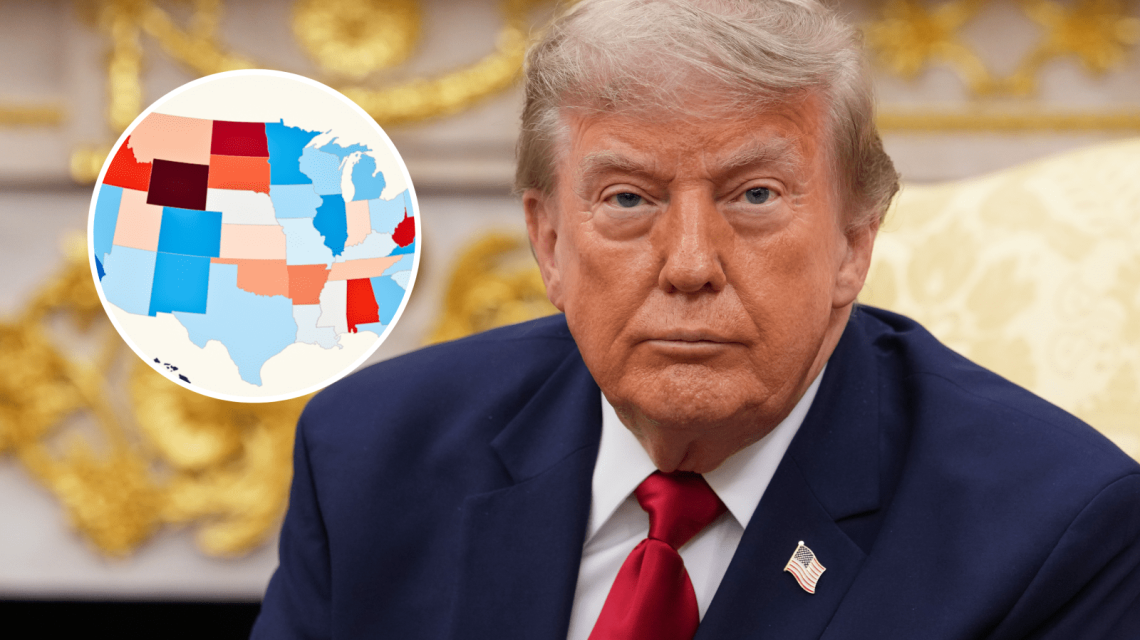
Eighteen months into President Donald Trump’s second term, polling reveals the enduring partisan divide in America, though several early advantages for the president have waned. Civiqs’ ongoing online tracking poll, involving 117,851 registered voters, shows Trump with 37% approval and 58% disapproval nationally, resulting in a net approval rating of -21.
State-by-State Overview
The state-by-state analysis mirrors the national picture. Trump retains strong support in Republican regions but faces significant disapproval in Democratic strongholds and battleground states.
Key Insights:
- Trump remains underwater in every major battleground state.
- Republican strongholds, including Wyoming, North Dakota, and Idaho, still exhibit strong support.
- Previously supportive states are now showing disapproval.
- Younger voters, independents, and postgraduates remain among Trump’s weakest supporters.
Polling shows Trump underwater in every swing state, indicating that minor shifts could impact Congress in 2026.
Deep Red States and Trump’s Core Support
Despite positive net approval in Republican heartland states, Trump’s support has diminished compared to the beginning of his second term. Wyoming leads with a +24 net approval, yet this is a significant drop from +47 in January 2025. North Dakota, Idaho, and West Virginia have seen similar declines.
Kentucky typifies this shift, moving from +23 net approval to a neutral stance at 0.
Battleground States’ Struggles
Trump is underwater across key swing states:
- Arizona: -11
- Georgia: -21
- Nevada: -21
- North Carolina: -13
- Pennsylvania: -14
- Wisconsin: -15
- Florida: -12
- Ohio: -11
Notably, states like Florida and Ohio have shifted from positive to negative since Trump’s return to office.
Persistent Opposition in Deep Blue States
Democratic states continue to display solid opposition to Trump. Hawaii has the lowest net approval at -59, followed by Vermont, Maryland, and Massachusetts. Opposition has remained steady since the start of his second term.
Demographic Insights
Demographic data further elucidates the map. Trump’s weakest performance is among younger voters and women, with only 24% approval among adults aged 18 to 34. Independents and postgraduates also show significant disapproval with 30% and 25% approval respectively.
Declining Approval and Tightening Margins
Every state shows a lower net approval rating than in January 2025, with marked declines in Republican-favoring areas. Wyoming and Kentucky are among those with the largest drops. Meanwhile, states such as Indiana, Utah, and Mississippi demonstrate tightened margins, reflecting a familiar but compressed partisan map.
Presidential Response
The White House maintains that Trump’s 2024 election win serves as the strongest indicator of public support. Spokesman Davis Ingle emphasizes the administration’s continued pursuit of a popular agenda, noting this as only the beginning of Trump’s legislative effects.
 Poll Reveals Voter Preferences Between Socialist Democrats and MAGA Republicans
  Challenges of Electing a Female President: Insights from ‘The View’
  Upcoming Concerns and Influence in Health Politics
  Rep. Donalds Distances Himself from Trump as Florida Governor Race Tightens
  Controversy Surrounds President Trump’s Proposed D.C. Arch
  AOC and the 2028 Presidential Election: Gender, Race, and Politics