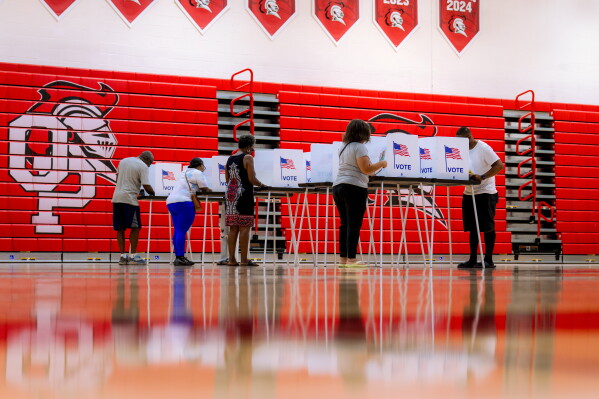
Democratic voters are participating in this year’s primaries in numbers not seen in decades. This trend is developing across several states, fueling optimism within the party about the upcoming November elections when control of Congress is at stake.
In a significant show of support, nearly 800,000 Democratic ballots were cast in Wisconsin’s primary, marking the highest midterm turnout in over 20 years for the state. Michigan saw 1.5 million Democratic voters, setting a midterm record.
This enthusiasm is not confined to the Midwest. There have been notable increases in Democratic voter participation in Texas and Georgia, two states with important Senate races this fall. The Democrats are experiencing a series of strong performances leading up to the midterms, a time when the president’s party often faces disadvantages.
President Donald Trump’s low approval ratings, coupled with ongoing inflation and an unpopular war with Iran, are contributing factors. David Axelrod, a former adviser to Democratic President Barack Obama, noted that the large Democratic turnout remains a consistent story during this period.
Competitive Democratic primaries have played a major role in boosting turnout, giving party voters reasons to engage. In contrast, Republican primary turnout in Michigan stayed closer to historical norms despite having a statewide contest.
Voter turnout in primary elections is not a perfect predictor of general election outcomes, especially when one party holds more engaging early contests. Republicans are responding by mobilizing their voter base for the fall, focused on leveraging their fundraising advantage and gearing up campaigning efforts, including a midterm convention in Texas.
Mike Marinella, spokesperson for the National Republican Congressional Committee, emphasized that primary turnout does not secure general election victories. He mentioned that House Republicans are preparing with ample resources, strong candidates, and a tested operation to mobilize voters when it counts most.
The scale of Democratic turnout has varied by state but shows a widespread pattern across areas with competitive House, Senate, or governor races. In Wisconsin, about 22% of registered voters participated in the Democratic primary for governor. Michigan saw over 1.5 million Democratic votes in its Senate primary, capturing more than 18% of registered voters, reflecting the highest midterm participation since 2002.
Minnesota mirrored its 2018 midterm Democratic primary turnout, reaching the most notable numbers seen so far in this century. Republican turnout in Wisconsin and Michigan remained consistent with past midterm primaries; the GOP continues to focus on revealing significant differences between candidates and energizing their base.
Other states, such as Georgia and Texas, also witnessed significant Democratic turnout rates. Georgia’s May Democratic governor’s race attracted over 1 million voters, over 13% of registered voters. In Texas, about 2.3 million participated in the March Democratic Senate primary, about 12% turnout.
The spirited primary turnouts are fueled by competitive races, though they may challenge Democratic unity. High turnout often stems from voters forming habits based on recent elections with high participation. In Michigan, large campaign spending and national attention characterized the Democratic Senate primary, with progressive Abdul El-Sayed narrowly defeating Rep. Haley Stevens.
In Wisconsin, the governor’s primary saw moderate Democrats cycle in and out of the race while Francesca Hong secured progressive backing. David Crowley, a more moderate candidate, narrowly won against Hong.
Winning candidates face the challenge of unifying the party for the general election, hosting unity breakfasts to bridge divisions. Sen. Bernie Sanders, backing both El-Sayed and Minnesota Senate nominee Peggy Flanagan, expressed confidence in Democratic voter unity for the general election to challenge Trump.
Democrats anticipate sustained enthusiasm. The president’s party frequently loses ground in midterms. Trump’s low popularity, including a 33% approval rating, presents a challenging situation. Despite a favorable national environment, Democrats must generate strong turnout to counter a congressional map more favorable to Republicans.
Republicans recently redistricted in favor of their party, minimizing competitive House races. As Republicans hold a narrow House majority, Democrats need four more Senate seats for control. The necessity of energizing Democratic voters parallels Republican efforts seen two years ago.
 Potential 2028 Presidential Candidates Begin Campaigning
 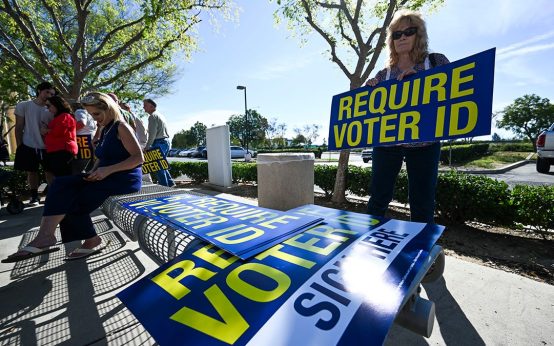 California Voter ID Proposal Sparks Debate
  Nevada Governor Race Heats Up as Election Day Approaches
  Rethinking Child Welfare Policy: A Call for Reform
  Trump Initiates Inquiry into Federal Reserve Governor Lisa Cook
  Michigan Senate Debate Highlights Intense Personal Attacks