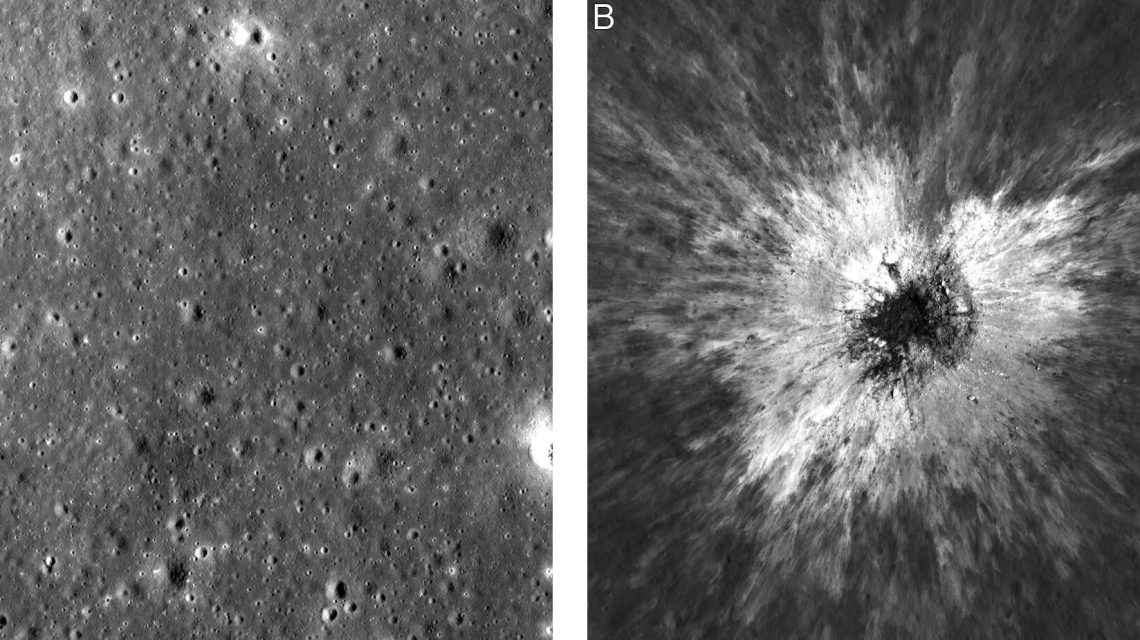
Scientists have found a crater on the moon that exceeds the size of the Roman Colosseum. This crater, resulting from a significant impact two years ago, initially went unnoticed. Measuring about 728 feet in diameter and up to 141 feet deep, this crater stands as the largest known impact site formed recently in the solar system, according to NASA.
Such large-scale impacts are expected to occur only once every 132 years. This event provides valuable data as NASA plans to establish an astronaut base on the moon. Researchers described this discovery as a rare opportunity, akin to a once-in-a-lifetime observation. These findings are detailed in a study published in the journal Science Advances.
Images from NASA’s Lunar Reconnaissance Orbiter (LRO) captured the crater on the moon’s near side between April and May 2024, soon after a sizable asteroid or comet fragment collided with the lunar surface. This impact was missed by Earth and space telescopes initially, and the LRO identified it later in August 2025.
The crater is named after Thomas McGetchin, a former director of Houston’s Lunar and Planetary Institute, and is substantially larger than the previous record-holding moon crater found a decade ago. The moon, with its long history of impacts, includes massive craters from ancient events, spanning over 1,500 miles.
This recent impact disrupted the lunar surface over an area of more than 66 miles. Dust and rock were propelled away at unexpected angles, noted Mark Robinson, the LRO’s chief scientist and lead author of the study. Additionally, a secondary study identified a 4-mile-wide cold spot around the new crater, suggesting the moon’s topsoil layer was disturbed.
“We’re now thinking of impacts as a way to garden the regolith — churning the sediments and putting stuff above that’s usually below the surface,”
explained co-author David Paige from UCLA.
Since its 2009 launch, the Lunar Reconnaissance Orbiter has offered close-up views of the moon as NASA gears up for future manned missions. The LRO’s findings suggest the moon’s top inch of soil turns over every 80,000 years, more frequently than previously believed. Contrary to popular belief, the footprints left by Apollo astronauts will erode over time, Robinson highlighted.
The next challenge involves assessing the risk of crater ejection material impacting NASA’s planned lunar base. Understanding these risks will aid engineers in strengthening structures to minimize potential damage.
 Concerns Rise Over AI Chatbot Safety, Legislation Faces Criticism
  Trump Announces Plan for AI Force and Czar Amid AI Regulation Debate
  US Faces Challenges in AI Competition with China
  AI Integration in Healthcare: Navigating Challenges and Opportunities
  Tropical Depression Six Forms in the Atlantic Amid Quiet Hurricane Season
  Scaling Generative AI and Overcoming Operational Challenges: Insights from the AI Impact Forum