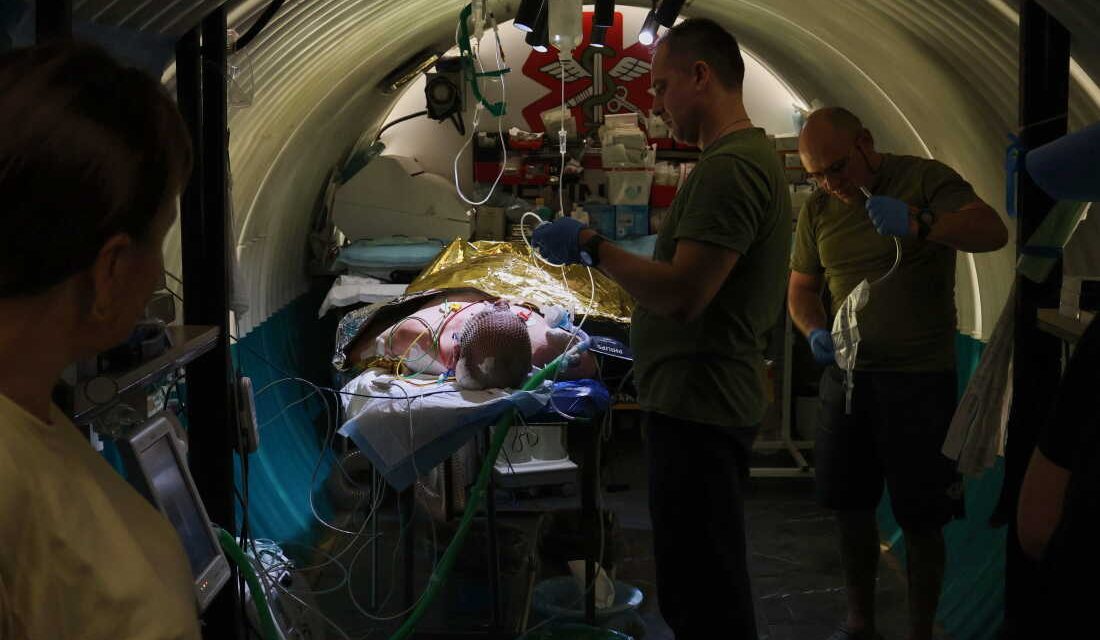
Ukrainian military medics attended to a wounded soldier in a field hospital near the front line in the Zaporizhzhia region on September 12. Most casualties occur in a “kill zone,” a territory about 10 to 20 miles wide on both sides of the front line, which spans over 700 miles from north to south.
In Ukraine, the ongoing conflict has resulted in a static front line, reminiscent of the trench warfare of World War I. Yet, unlike its historical counterpart, this zone is now ruled by rapidly advancing drone technology, changing the battlefield landscape.
Lt. Taras Myshak of Ukraine’s 59th Separate Assault Brigade describes this zone as filled with Russian drones, mines, and artillery, involving constant reconnaissance. Myshak detailed the dangers of moving through this area during a conversation with NPR near the eastern front.
“Even a simple movement can attract drone attention and lead to attacks,” said Myshak.
Rotating troops through the zone is particularly difficult. At times, soldiers must wait and hide from drones, moving just a kilometer in four hours. Traveling at night isn’t safer; thermal cameras make it challenging to remain unseen.
Ukrainian forces, like their Russian counterparts, often rely on foot or bicycles to stay under the radar, as larger vehicles are easier targets.
A Front Line That Barely Moves
Russia’s full-scale invasion in 2022 initially saw rapid ground advancements. However, following a Ukrainian counteroffensive, this momentum stalled. The nearly 700-mile front line remains largely unchanged.
Rob Lee from the Foreign Policy Research Institute explains that Ukraine, with fewer troops but substantial reliance on drones, maintains a minimal presence on the ground. Some areas have fewer than ten soldiers per mile in dispersed groups serving primarily as reconnaissance spotters.
“Drones have made it virtually impossible to assemble a large force without detection,” Lee noted.
Due to high drone density, bringing military vehicles near the front line is exceptionally challenging.
Increasing Focus on Drone Technology
Neither Ukraine nor Russia initially anticipated such a drone-centric warfare style. As the conflict progressed, drone production escalated significantly. Ukrainian President Volodymyr Zelenskyy projects 10 million drones produced this year, with Russia following closely.
Dima Putiata, formerly in Ukraine’s military, was initially skeptical of drone usage. Over time, however, this perspective shifted. Putiata eventually commanded numerous drone crews, acknowledging the necessity to adapt rapidly to evolving warfare.
Recognizing the Growing Role of Drones
Ukraine was the first to formally integrate drones as a separate military branch. Ground drones conduct tasks too hazardous for human troops, such as supply deliveries and evacuations from high-risk zones.
“A combined program is necessary to train medics alongside drone operators,” said Lyuba Shipovich, leader of a group that aids in troop training.
While long-range strikes within Ukraine and Russia receive much attention, the bulk of fighting occurs within the kill zone. Experts like Rob Lee estimate drones cause 80% of current casualties.
Putiata remarked, “Drone warfare is now more economical and widespread, likely shaping future conflicts worldwide.”
 Israel Condemns British Green Party’s View on Zionism
  U.S. Military Executes Lethal Strike on Suspected Drug-Trafficking Vessel in Caribbean
  U.S. Actions in the Strait of Hormuz Face Sustainability Challenges
  Escalating Violence in French Student Protests: A Call for Peaceful Solutions
  California Realtor Arrested for Alleged Espionage Activities
  U.S. Monitors Possible Pneumonic Plague Case in Russia