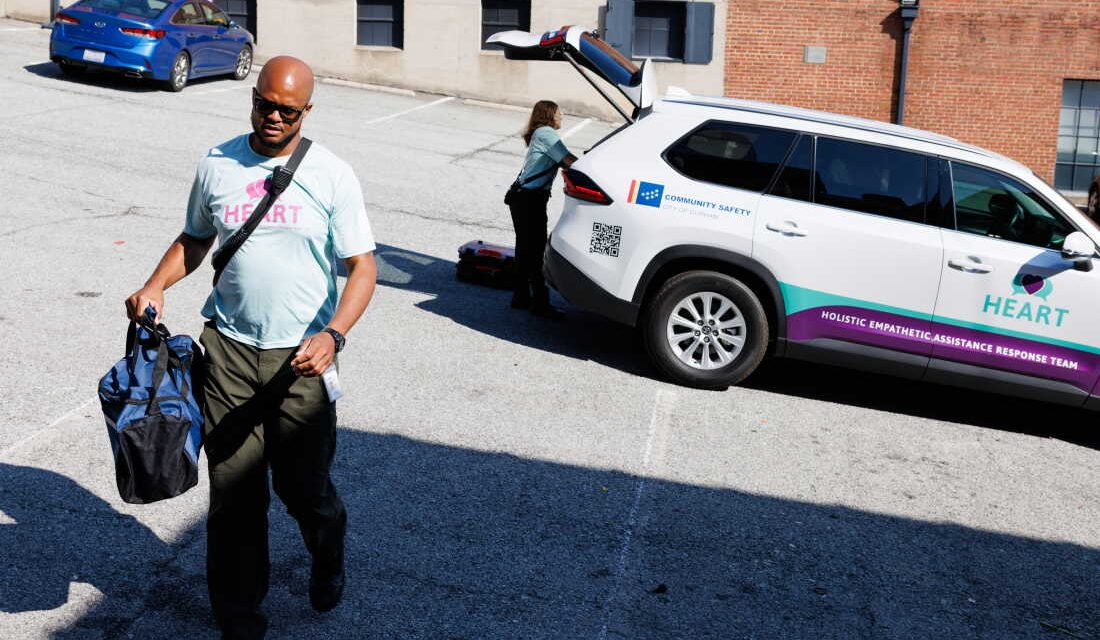
Rob Crisp, serving as a peer support specialist with the Holistic Empathetic Assistance Response Team (HEART) in Durham, N.C., was recently called to a wellness check on September 14. Responding to calls as part of an unarmed community response team, Crisp and his colleague, Allie Craft, were equipped with essential supplies such as snacks, bottled water, and hygiene kits. Their mission involved aiding a man on a business property, a trespasser who refused to leave and was carrying several belongings.
Upon finding the man, Crisp engaged him with empathy, understanding his resistance and assuring him of their peaceful intentions. Drawing from his experiences of overcoming personal challenges, Crisp offered a connection, ultimately calming the man. They provided him with basic necessities and convinced him to relocate his possessions, resolving the immediate situation.
Prior to the establishment of HEART and similar programs, such calls would typically involve police intervention. However, following the police killing of George Floyd in 2020, numerous U.S. cities have embraced the concept of unarmed responders handling specific 911 calls. These initiatives, once limited to six U.S. programs in 2020, have now expanded to nearly 100 cities, reinforcing alternative or community responses.
The HEART program in Durham, launched in 2022, exemplifies this shift, having responded to over 25,000 calls citywide. It features a unique partnership where mental health clinicians collaborate with police officers and even integrate with the city’s 911 call center. Ryan Smith, directing the Durham Community Safety Department, views successful deployment of social workers in place of law enforcement as a positive indicator of the program’s efficacy.
“If a social worker can address issues typically handled by police and achieve similar outcomes, it signifies success,” says Ryan Smith.
Research from Duke University and the Research Triangle Institute (RTI) evidences HEART’s effectiveness, noting increased public trust and a decrease in arrests related to the program’s implementation. Similarly, other nationwide community response programs have demonstrated significant benefits, including crime reduction and improved access to medical care.
Despite initial skepticism and challenges, such as concerns from law enforcement, HEART was eventually accepted as a vital component of public safety in Durham. The integration of responders and the police on the same communication channel fostered this acceptance, highlighting collaboration within the public safety framework.
Yet, the scope and capabilities of alternative response programs remain a topic of concern. In instances of critical oversights, such as in New York City and Baltimore, these programs faced scrutiny over their coverage and effectiveness. Durham’s approach, under the guidance of the Law Enforcement Action Partnership (LEAP), stands out, managing around 28 calls per 1,000 residents, ranking it among the top in U.S. call volume by LEAP standards.
However, the broader challenge persists: determining the long-term impact and scalability of these programs. As more communities analyze and refine their strategies, funding and call types continue to determine the programs’ reach and application. In Durham, the focus encompasses various non-violent issues, shifting the paradigm to include types of calls previously not deemed urgent.
Another key challenge is addressing systemic issues highlighted by recurring calls. Crisp and Craft, during a call involving a mother-daughter dispute, encountered the persistent issue of housing insecurity. While resources for immediate assistance exist, the absence of long-term solutions complicates the response to such community needs.
Efforts to expand the program’s impact include the establishment of Stabilization Services within Durham’s Community Safety Department. Anise Vance, leading this division, aspires to connect community members with essential resources like housing and healthcare, aiming for a sustainable resolution beyond the initial crisis intervention.
Ultimately, the ambition for community response programs like HEART lies in reducing the future necessity of such interventions by addressing foundational societal challenges. While still in development, these initiatives represent a commitment to evolving public safety solutions.
 Tropical Storm Polo Threatens to Impact Southern California
  Shooting at South Los Angeles Senior Facility Leaves Three Injured
  Missouri’s Ongoing Abortion Amendment Debate
  Karoline Leavitt on Trump’s Direct Diplomacy
  Philadelphia Reports Measles Exposures at Airport and Hospital
  Virginia’s Data Center Plan Sparks Tensions Over Energy and Environmental Goals