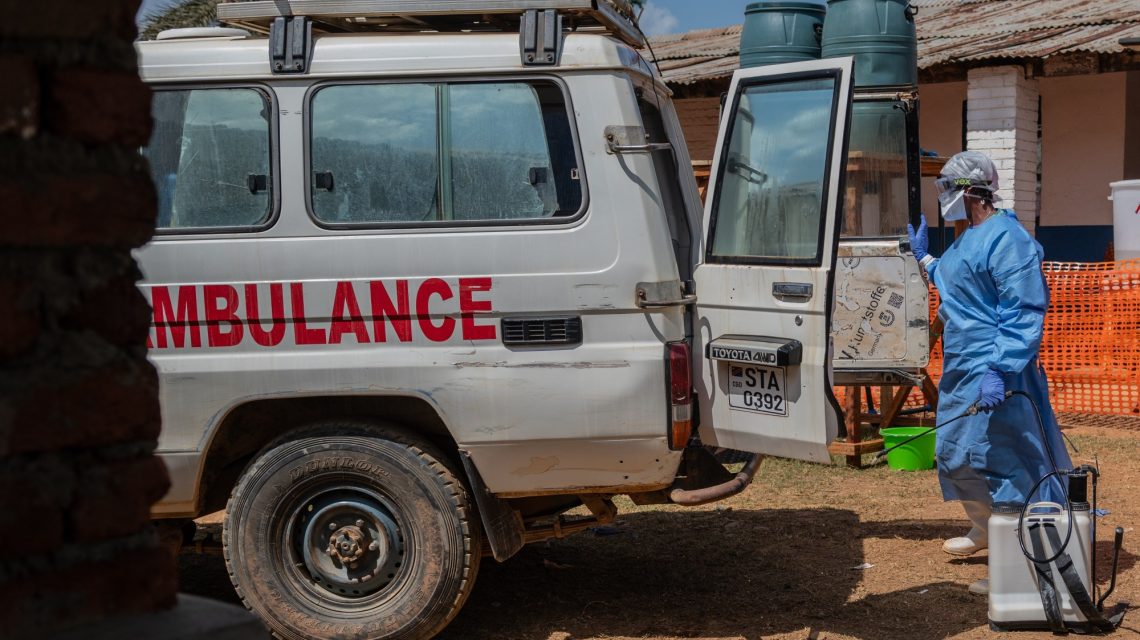
A health worker disinfects an ambulance at the Mongbwalu treatment center in Congo, after transporting a suspected Ebola patient. The Democratic Republic of the Congo and Uganda have seen 617 confirmed Ebola cases, resulting in 117 deaths.
The Trump administration’s proposal to establish a quarantine and treatment facility for potential American Ebola cases at a U.S. military base in Kenya is facing criticism and legal challenges. U.S. healthcare officials warn that such a policy raises significant clinical, ethical, operational, and legal issues.
Ebola outbreaks are not uncommon. The current situation mirrors the 2014-2016 Western Africa outbreak, which had over 28,000 cases and more than 11,000 deaths—a 39% fatality rate. Unfortunately, past lessons seem forgotten as inadequate plans are proposed without sufficient actions to contain the virus.
In 2014, international airport screenings were implemented to prevent the virus from entering the U.S. Before this, four U.S. cases were confirmed, with one death. Resources were allocated to establish world-class medical facilities for treating infected individuals while preventing the virus’s spread. These facilities remain available to provide quality care today.
However, the current U.S. public health infrastructure faces challenges. Over the past 17 months, it has been gradually dismantled. The U.S. Agency for International Development no longer offers essential support in the Congo, and the Centers for Disease Control and Prevention (CDC) faces budget cuts and political oversight, reducing its efficacy.
Infectious disease outbreaks can easily spread. The best strategy to prevent Ebola from spreading is to contain and extinguish the disease at its source. Although the CDC is present in the Democratic Republic of the Congo, their efforts are less robust compared to a decade ago. The withdrawal of the U.S. from the World Health Organization has worsened the situation. The continuing outbreak increases the risk of Ebola spreading beyond Central Africa.
With air travel, infected individuals have pathways to other regions. Events like the FIFA World Cup heighten these risks as people gather globally. Any exposed individuals seeking quality care, particularly U.S. residents, should access state-of-the-art facilities available in the U.S. Restricting their entry is not effective, especially since Ebola symptoms can take up to 21 days to emerge. Current medications can temporarily mask symptoms, making entry restrictions impractical.
The longer Ebola persists in Congo, the harder it becomes to control its spread. Although transmission is primarily through contact with bodily fluids and not airborne, risks are not zero. Protecting Americans requires containing the virus at its origin. Airport screenings and barriers offer limited advantages, akin to preventing a fire with a barrier rather than extinguishing it.
Learnt lessons from aviation security highlight the importance of focusing resources on risks. Risk-based strategies like TSA PreCheck show how prioritizing risks effectively helps mitigate potential threats. Applying this to Ebola, containing the virus at its origin is crucial for protection. Mitigating risks demands understanding sources and utilizing resources to address them proactively. Thus, aggressive containment of the Ebola outbreak in Congo should be prioritized.
Sheldon H. Jacobson, Ph.D., professor of Computer Science at the University of Illinois Urbana-Champaign, has extensively researched risk-based aviation security. Janet A. Jokela, MD, MPH, FIDSA, MACP, an infectious disease physician and clinical professor at Carle Illinois College of Medicine, serves on the Illinois Immunization Advisory Committee.
 Recall of Meat Products from Star Meat Delivery Inc.
  Questions Arise After Presley Gerber’s Death in Rehab
  Upcoming Concerns and Influence in Health Politics
  Fraud Task Force Saves Billions by Tackling Obamacare Misuse
  Presley Gerber’s Passing Raises Addiction Recovery Concerns
  Understanding October SNAP Benefits: Payment Dates and Changes