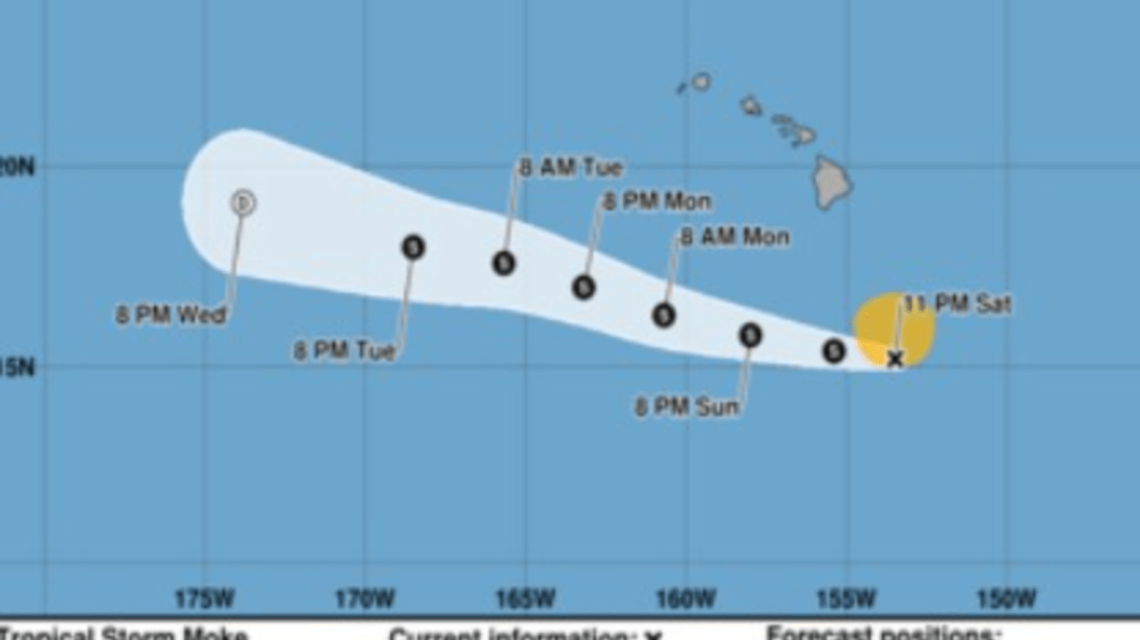
The U.S. state of Hawaii is bracing for potentially life-threatening flooding due to Tropical Storm Moke, which hit the region Sunday. This comes shortly after the islands suffered damage from Tropical Storm Lala. According to the National Hurricane Center (NHC), winds reached 45 mph on Saturday evening, with the storm’s center expected to travel south of the Big Island on Sunday, extending further south of other islands next week.
Heavy rainfall is predicted to impact the Big Island early Sunday, spreading westward throughout the day. Animated weather footage from windy.com highlights the expected rainfall range of 5 to 10 inches, peaking at 15 inches in some locations. Eastern Maui is anticipated to receive 3 to 6 inches on average, while other islands might experience 1 to 2 inches of rain.
The NHC warned, “This rainfall may produce life-threatening flooding and mudslides for the windward and southeast Big Island, especially in steep terrain and over areas previously impacted by Lala.” Although Moke’s strongest winds are expected to move south of the Hawaiian Islands, gusty winds are probable, particularly downslope from higher terrain.
Maui County Mayor Richard Bissen noted that, given Lala’s impact earlier this month, even lesser degrees of rain and wind could initiate flooding, debris, downed trees, roadway issues, and power outages. He stated, “County departments have been preparing for Tropical Storm Moke, and we’re asking our community to do the same.”
Tropical Storm Lala developed as the second named storm in the Central Pacific and ninth across the wider Pacific basin in 2026. While downgraded by landfall, Lala brought substantial rainfall and winds to the Big Island, with accumulations reaching 3.5 feet in some areas over 48 hours according to AccuWeather. This led to around 100 damaged or swept-away homes, destruction of six bridges, over 100,000 power outages, and millions in damages. Governor Josh Green confirmed one fatality in a weather-related car incident.
Simultaneously, Randy Collins, Hawaii’s emergency management director, acknowledged risks in the cleanup operation from heavy equipment, chain saws, and generators. Additionally, Hurricane Fausto posed threats in July, ultimately weakening and moving north of the islands. Despite Moke’s lesser projected rainfall compared to Lala, the risk remains significant due to already saturated ground.
The 2026 Hurricane Season Overview
Hawaii hasn’t seen a direct hurricane landfall since Iniki in 1992. Earlier this month, Hurricane Lala’s eye lingered 30 miles off the Big Island’s coast as a Category 1. Hawaii typically benefits from protection against tropical cyclones due to cooler sea-surface temperatures and strong vertical wind shear, but this year’s extended El Niño has warmed ocean waters, enabling cyclone development.
In mid-June, Tropical Storm Arthur marked the Atlantic hurricane season’s first named storm, impacting the U.S. Gulf Coast with heavy rain and flooding. Up to mid-August, few named storms emerged, and no hurricanes formed, aligning below the average for the period. However, the typical peak of hurricane season occurs in September, suggesting heightened activity may still surface.