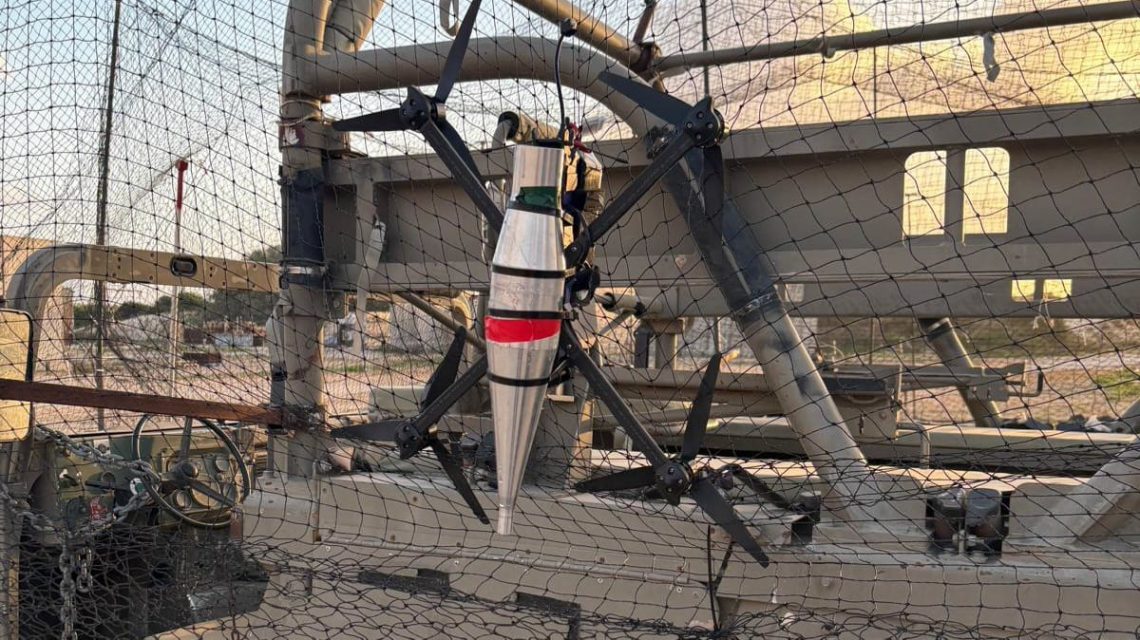
Hezbollah has intensified pressure on Israel and the United States, employing advanced tactics in the Middle East conflict. Recent months have seen significant changes, particularly with the introduction of fiber-optic first-person view (FPV) drones in Hezbollah’s arsenal. These drones, familiar from the Russia-Ukraine war, were first observed in Hezbollah’s activities in March, following an escalation related to the U.S.-Israeli conflict with Iran beginning on February 28.
A report from the Armed Conflict and Location Event Data (ACLED) monitor revealed that Hezbollah used FPV drones in 21% of their attacks over the past five months. This includes over half of the 33 documented incidents involving Israeli casualties. Use of one-way attack, or suicide drones, also increased, rising to 24% from a previous 6% during heightened tensions following Israel’s cross-border invasion and subsequent ceasefire after Hezbollah backed the Palestinian Hamas movement’s 2023 offensive.
Overall, Hezbollah’s operations, including rocket launches, rose from an average of 163 to about 199 per month during the recent war phase. FPV drones have proven effective in applying military pressure on Israeli forces, causing casualties, and allowing strikes from remote locations avoiding detection. By maintaining these capabilities, Hezbollah seeks to apply psychological pressure on northern Israeli communities and test Israeli defenses.
Recent developments have forced Israel to counteract Hezbollah’s drone threats. In May, an IDF official noted that the Technological Brigade started providing troops with wire mesh nets in Lebanon specifically designed to neutralize explosive drones. By then, Israel accumulated 158,000 square meters of netting, with more on the way.
Strategic Innovation Against Superior Technology
Hezbollah’s strategy of countering technologically superior foes dates back to clashes in the 1980s. During the 2006 war, Hezbollah used Russia’s Kornet anti-tank guided missiles (ATGMs) to pierce Israeli Merkava tanks. In 2015, they adapted these to bypass Israeli active protective systems.
The third major confrontation since October 2023 saw Hezbollah deploy the Almas-1 ATGM, reportedly derived from Israeli Spike-MR systems captured during the 2006 conflict. Unlike laser-guided Kornets, the Almas-1 relies on fiber optics for ‘fire-and-forget’ capabilities. Despite these advancements, Israeli counterstrikes with drones impeded Hezbollah’s capacity to repel invasions effectively.
“Hezbollah aimed to repel Israeli advances but their arsenal quickly became obsolete,” defense analyst Hamze Attar told Newsweek. “They adapted Ukraine conflict lessons, utilizing fiber optic technologies for greater tactical advantage.”
Sources indicate Hezbollah’s shift towards technology to gain a ‘qualitative advantage’ against Israel. Easy to operate FPV drones, linked to Lebanese gaming culture, represent this strategic pivot. Proficiency in video games has contributed to operators’ efficiency in drone warfare.
Training on new weapons traditionally takes time; however, the familiarity with joysticks speeds up this process. Operators may train through simulation and practice, leveraging the drones’ extended range for safety.
Diplomatic Challenges Amid Evolving Tactics
Hezbollah’s evolving approach complicates political goals for Israeli Prime Minister Benjamin Netanyahu and former U.S. President Donald Trump amid electoral contexts. Since a sought ceasefire with Iran, the U.S. has pushed for a separate Lebanon truce involving Israel, Hezbollah, and the Lebanese government. However, consistent accusations of agreement violations persist between Israel and Hezbollah.
The Lebanese government demands the withdrawal of Israeli forces, while Hezbollah insists on resistance as long as occupation continues. Disagreements have stoked fears of sectarian tensions.
Despite weakened capabilities, Hezbollah remains a critical factor in Iran’s regional influence, diverging from U.S. and Israeli strategies. As talks brokered by the U.S. continue, conflict persists, and Hezbollah showcases tactical resilience.
Newsweek editors Tom O’Connor and Dave Siminoff can be contacted for more information.
 Ukraine’s Satellite Access Crisis: Starshield Restrictions and Implications
  Hurricane Trudy Approaches Mexico’s Pacific Coast
  ADL Criticizes Wikipedia for Failing to Address Bias in Israel-Related Content
  Sally Rooney’s Books Pulled From UK Shelves Over Support For Palestine Action
  U.S. Military Expands Operations in Latin America
  Salvadoran President’s Plan for Conditional Early Prisoner Release