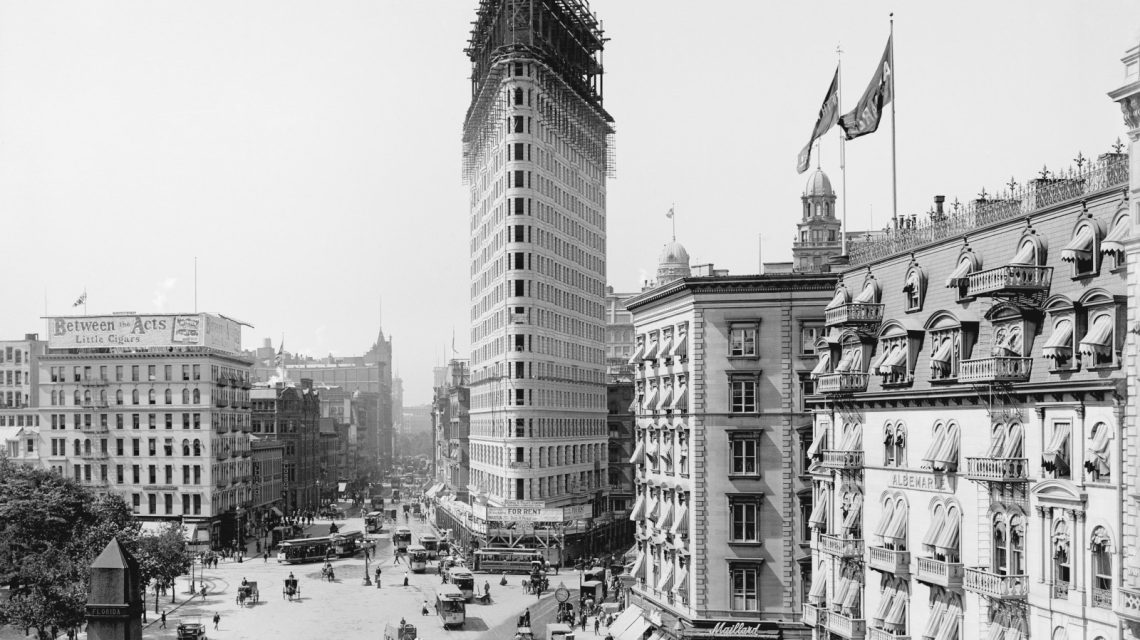
More than a century before Manhattan’s skyline was dominated by towering skyscrapers, a new piece of footage showcases one of New York City’s earliest high-rise structures. Captured on October 8, 1902, and shared by the Library of Congress, this black-and-white film reveals a panorama of the recently completed Flatiron Building.
The film begins at street level, showing bustling Manhattan streets filled with pedestrians, before gradually panning upwards to the top of the 24-story building. According to the Library of Congress, the footage provides “a view looking south from Madison Square, across the intersection of Broadway, Fifth Avenue, and Twenty-third Street, to New York’s famous skyscraper, the Fuller (or ‘Flatiron’) Building.” The cameraman elevates the lens from street level to the roof.
Completed in 1902, the 307-foot-tall Flatiron Building was among the world’s first skyscrapers, known for its unique triangular shape and pioneering steel-frame construction. Today, the Flatiron Building is undergoing significant changes, as it transforms into private residences. Last month marked a milestone when the landmark was illuminated for the first time in its 124-year history.
This conversion is part of a broader trend of restoring and repurposing historic buildings across New York City and the United States. The American Institute of Architects highlights that nearly half of America’s 125 million buildings are over 50 years old. A report by RentCafe indicates that almost 25,000 apartments were created through building conversions nationwide in 2024, reflecting a 50 percent increase from the previous year.
An Iconic Structure of the Past
In the early 20th century, the Flatiron Building signified a transformative period in New York City’s architectural landscape. Historian Kevin Draper from NY Historical Tours notes, “The Flatiron Building was one of New York City’s first skyscrapers at that time.” Many residents questioned the need for such tall structures and raised concerns about their impact on the area’s surroundings.
This debate mirrors contemporary discussions about supertall buildings like those on Billionaire’s Row, which are criticized for casting shadows on Central Park. Draper remarked, “People were already contemplating laws to limit building heights and prevent skyscrapers from becoming overtly tall.” This footage highlights the building’s dominance as it stood towering over its surroundings when it opened. Today, it might appear smaller compared to the modern towers nearby.
Everyday Manhattan Life in 1902
Besides its architectural significance, the film offers a rare glimpse into everyday life in Manhattan at the beginning of the 20th century. “The streets still seem crowded, and people appear in a rush, much like today,” Draper noted.
The footage also captures a city in transition, showing the early stages of modern transportation. A single “horseless carriage” can be seen, while numerous streetcars and horse-drawn carriages dominate the scene. While streetcars are now extinct in New York, horse-drawn carriages survive mainly as tourist attractions around Central Park.
The Flatiron Building emerged during a crucial phase in New York’s architectural history. Advances in steel-frame construction and elevator technology enabled structures to reach unprecedented heights, reshaping Lower Manhattan and Midtown. Prior to the Flatiron, structures like the New York World Building and the Park Row Building marked New York’s entry into the skyscraper era. However, the Flatiron stood out for its distinctive design and prime location.
Over 120 years later, this historic video footage serves as a reminder of when the Flatiron symbolized the future of urban architecture and New York’s ascent into the skyscraper age.
 Silence in the Media: Ignoring Important Stories
  Examining the Controversy Surrounding Sophie Cunningham
  Lake Forest Preservation Symposium Emphasizes Community and Future
  Jackson Pollock and Lee Krasner: Art and Legacy in Springs, N.Y.
  AI’s Growing Influence in Literature
  Bayeux Tapestry Visits England After Almost a Millennium