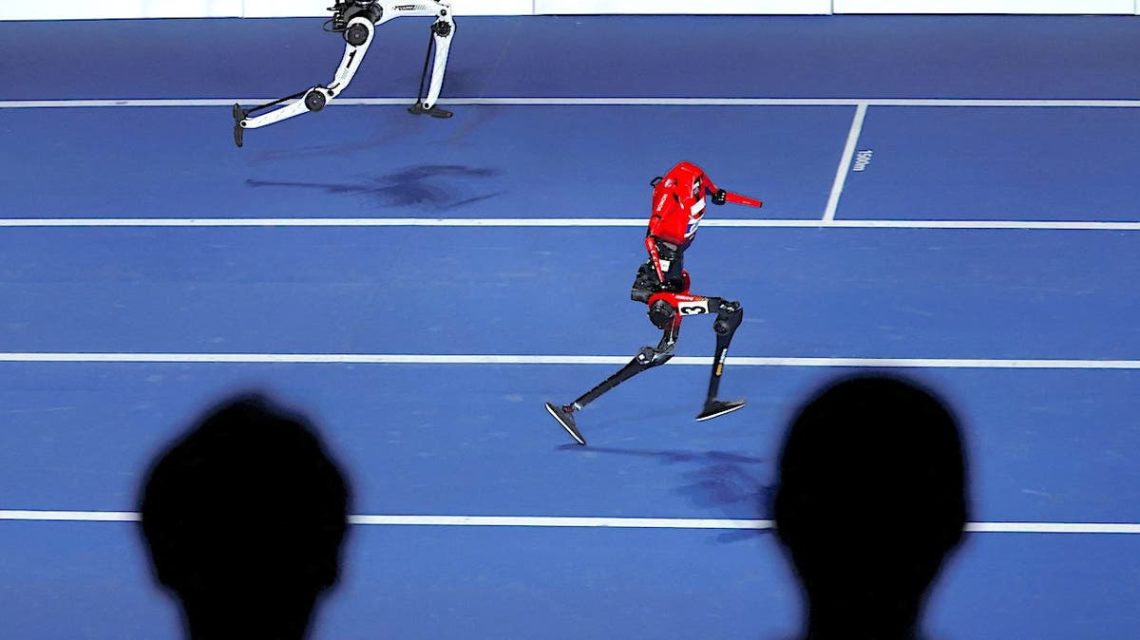
Recent developments at the World Humanoid Robot Games have made headlines, as humanoid robots break speed records set by humans. On the first day of the games in Beijing, a robot named ‘Lightning Bolt’ completed the 100-meter dash in a time of 9.39 seconds, surpassing Usain Bolt’s 9.58-second record from 2009. A robot from Chinese smartphone company Honor also shattered records during pre-game trials, running 100 meters in 9.32 seconds at a peak speed of 14.5 meters per second.
The aftermath of these record-breaking runs saw robots crashing into walls and being placed on stretchers. This stands in stark contrast to Usain Bolt’s iconic jog to celebrate his achievement in 2009. The event showcased the impressive potential of humanoid robots despite their current inability to stop effectively without help.
Robots also posted impressive achievements in other events. One humanoid robot surpassed the human standing high jump record by clearing 2.88 meters, well above both the previous best humanoid jump of 0.95 meters and the human record of 2.45 meters set by Javier Sotomayor in 1993.
The World Humanoid Robot Games feature over 2,000 robots competing in 51 events. The competitions include a variety of activities like running, table tennis, and soccer. This five-day spectacle underscores China’s rapid advancement in robotics amid an ongoing technological rivalry with the United States.
The games, held at the National Speed Skating Oval in Beijing, run parallel to the 2026 World Robot Conference. Here, companies have displayed around 3,000 products, including humanoid robots, emphasizing China’s progress in this field.
Some observers expressed excitement at the robots’ evolving abilities. Li Yanfeng, an education worker, noted the rapid development of AI after initial hesitance due to concerns over human displacement. Another spectator, Yang Shangzheng, marveled at the robots’ capacity to perform activities traditionally reserved for humans.
The 2026 edition of the games welcomes participants from 16 countries, including Germany, Japan, and the U.S. The event encompasses diverse competitions such as weightlifting and tug of war, highlighting international interest and collaboration in robotics.
Amid these advancements, the U.S. has tightened scrutiny on Chinese robots due to national security concerns. Recently, the Federal Communications Commission, under guidance from President Trump, prohibited imports of foreign-made humanoid robots to safeguard critical supply chains.
FCC Chair Brendan Carr expressed approval of these measures, emphasizing their role in securing America’s safety and security.
Reporter Eric Mack contributed to this analysis, covering breaking news and areas such as politics, elections, and foreign affairs.
 Carney’s Stand Against U.S. Tariffs: An Economic Test for Canada
  Governor Abbott Criticizes Data Center Developers Amid Growing Opposition in Texas
  Tensions Rise Over Starlink Use in Ukraine Conflict
  Middle East Tensions Rise Amid Political and Military Maneuvers
  Exploring Palmyra Atoll’s Ecosystem Amid Protection Changes
  Tropical Storm Moke Threatens Hawaii with More Flooding