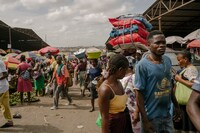
In Luanda’s bustling Catinton Market, vendors sell fruits and vegetables beneath umbrellas that scarcely provide relief from the intense sun. Despite being physically distant from the U.S.-Israeli war on Iran, Angola feels its economic ripple effects.
This African nation, home to 40 million people, is marked by stark inequality. While half the population survives on less than $3.65 a day, oil wealth benefits a privileged few. The ongoing Iran conflict has intensified this disparity.
Angola is unique among oil producers for not routing its supply through the Strait of Hormuz. Consequently, while rising costs of food, fuel, and fertilizer burden the poor, the affluent benefit from increased reliance on Angolan oil.
Market Struggles
At Catinton Market, many struggle with the economic strain. Veronica Simon and Isabelle Ferreira endure these difficulties firsthand as they sell red peppers. Despite working side-by-side, they find it challenging to afford their children’s education due to skyrocketing costs. Since February, the price of a box of peppers has quadrupled without clear reason.
“It is not enough, but what can we do?” Simon expressed, referring to their daily earnings.
Economic Disruptions
This conflict is yet another economic shock for developing nations like Angola. Economist Arsénio Bumba notes that it exacerbates global economic uncertainty, driving up import costs and disproportionately affecting the poorest households.
Despite these hardships, Angola’s government sees financial gains from rising oil prices. Oil contributes significant portions to the nation’s GDP, government revenue, and exports, as reported by the World Bank.
Budget and Government Efforts
The Angolan government had based its 2026 budget on oil selling at $61 per barrel, but Brent crude has risen to about $87 per barrel. This windfall is being used to reduce debt and create reserves of food and medicine to mitigate supply disruptions. Efforts are also underway to control inflation.
However, those living along Luanda’s trash-filled waterways feel left behind and express discontent regarding political corruption. With a presidential election approaching, there is mounting pressure to address poverty in this former Portuguese colony.
Life in Bairro da Lixeira
Eva Damiao, 82, resides amidst the mounds of trash in Bairro da Lixeira. She and her grandchildren depend on each other’s support. The neighborhood suffers from irregular electricity and lacks running water. Residents are skeptical about benefiting from the government’s newfound riches.
Similarly, Joveth Hebo, 33, shares his challenges. Once a law student, financial burdens forced him to leave his studies. He taught himself English and now navigates an economy with rising prices and little personal shopping.
Hebo and his friends often sift through Luanda’s garbage dumps for scrap metal, believing that the economic benefits accruing from the conflict will enrich only the elite.
“It won’t help us. It will help them. The majority of us are suffering, and they don’t care about us,” Hebo laments.
Families once residing near Luanda’s lagoon were displaced for developmental projects, further highlighting the ongoing socio-economic divide.