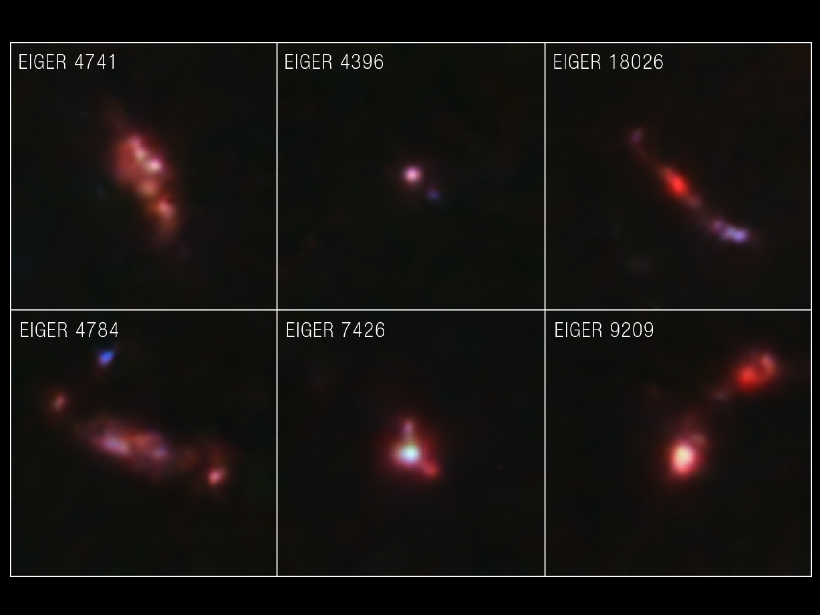
The James Webb Space Telescope (JWST) has delivered astonishing images and spectra from when the universe was merely 900 million years old. This powerful telescope, a joint effort by NASA, ESA, and CSA, has changed astronomy profoundly by reaching farther and more ancient galaxies than ever thought possible.
According to Jorge Moreno, an astronomy professor at Pomona College, understanding our cosmic history resembles paleontology. Scientists must look back in time, though without a time machine. They explore distant spaces to uncover the universe’s past. Despite expectations, JWST has discovered that galaxies appeared far sooner than anticipated, with many forming just 200-500 million years after the Big Bang. These findings present a compelling puzzle for astronomers around the globe.
One surprising aspect is the galaxies’ size and brightness. The telescope’s ability to observe these early formations is due to its capacity to detect faint light, which, due to cosmological redshift, shifts into the infrared range unseen by the human eye.
Light deviates as it traverses the expanding universe. For example, sunlight takes approximately eight minutes to reach Earth, whereas light from Proxima Centauri travels for over four years.
Moreno compares the situation to observing a teenager in a kindergarten. The unexpected bright light suggests a greater size or mass, though this assumption may not always hold. Supermassive black holes or hot dust within these galaxies could distort perceptions of mass, projecting brightness greater than their true mass.
Galaxies typically classify into two types: spiral and elliptical. Researchers believed early galaxies were too young to fit into this binary classification, expecting them to appear as unstructured blobs. Contrary to this belief, JWST reveals galaxies with sophisticated structures.
The discovery prompts some astrophysicists to question the universe’s age. A recent article suggests the universe’s age as roughly 26.7 billion years, double the accepted 13.8 billion years. This theory emerges from merging two universe models: one for expansion and the debunked tired light model suggesting light’s energy decreases as it travels. Although some find this proposal intriguing, Moreno stresses that without extraordinary evidence, simpler, established models should prevail.
Moreno urges caution against adopting unproven claims about the universe’s age because no confirmed evidence of stars older than 13.8 billion years exists. He emphasizes the importance of pausing and reflecting on the lessons these findings provide, highlighting the alternation of brightening and dimming phases in galaxies. Moreno believes that experiencing excitement for discovery and reserving time for thoughtful contemplation are both crucial.
The James Webb Space Telescope continues to supply NASA with ample data, revealing new possibilities and presenting more challenges to existing cosmological models.
 The Growing Threat of Glacial Lake Outbursts and the Urgent Need for Mitigation
  SpaceX Falcon 9 Delivers Crew to International Space Station
  California to Vote on $7.5 Billion Scientific Research Fund
  NASA Collaborates with Boeing to Launch Unpiloted Starliner Test
  Winter Weather Forecasts for 2026-2027
  Underwater Discoveries: Exploring the Lost Town of Shipden