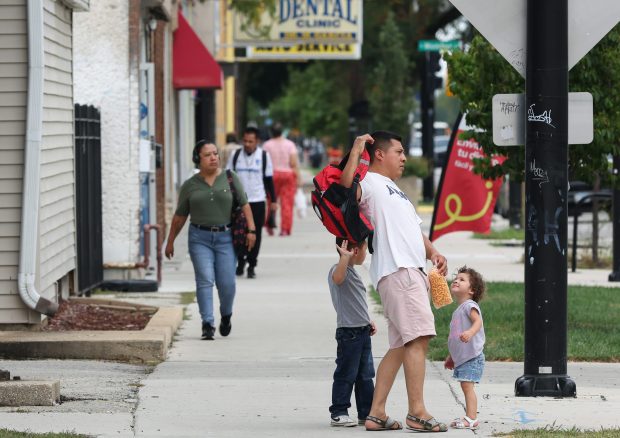
Little Village has long been a cultural hub for Latino Chicago. This was evident as thousands gathered for the 55th annual Mexican Independence Parade along the 26th Street corridor. However, a new study from the University of Illinois Chicago (UIC) shows a shift in the largest Latino population in the city. Belmont Cragin, located on the Northwest Side, now holds the title.
According to the report released by UIC’s Great Cities Institute, Belmont Cragin’s Latino population surpasses all other neighborhoods in Chicago. Out of nearly 802,000 Latino residents citywide, more than 57,000 live in Belmont Cragin, making up approximately 80% of the neighborhood’s population. The study observes changes in living patterns, income, education, and employment, illustrating a Latino presence expanding beyond traditionally known areas.
Oswaldo Alvarez, executive director of the Illinois Legislative Latino Caucus Foundation, emphasized the importance of understanding the varied facets of the Latino community. He noted the community’s role in advancing Chicago despite challenges.
“For us, it’s about taking a comprehensive look at who the Latino community actually is,” Alvarez said. “It’s about having a snapshot of who the Latino community is and how the Latino community has been able to bring Chicago to its next level, without necessarily Chicago’s help.”
Belmont Cragin is diverse with Mexican, Puerto Rican, Central American, and South American populations. The study highlights this alongside the active commercial presence along Fullerton Avenue, which generated $181 million in taxable sales in 2024. Fullerton Avenue is now Chicago’s busiest commercial corridor, beating the “Mexican Magnificent Mile” on 26th Street.
The diversity of Belmont Cragin is visible through businesses and community interactions. Luisa Rodriguez owns Niko’s Multiservices and Cell, serving clients from Guatemala, the Dominican Republic, and Honduras. This reflects a wider pattern in the city where Northwest Side neighborhoods showcase significant Latino diversity.
The report identifies an increase in Latino residents in areas like Austin, Garfield Ridge, Chicago Lawn, Ashburn, Clearing, and West Lawn. Conversely, traditional Latino communities, such as Logan Square, Avondale, Albany Park, Irving Park, and Pilsen, are seeing population declines. Housing costs and gentrification are key factors influencing these shifts.
Alvarez acknowledged rising rent prices and low housing stock, causing displacement from central areas. Sixty percent of Latino renters spend more than a third of their income on rent and utilities. Despite this, opportunities for homeownership are increasing in places like Ashburn and Garfield Ridge, with Latino homeownership exceeding 80%.
A growing Latino middle class is emerging, evidenced by rising household incomes and educational attainment. The percentage of Latino households earning at least $100,000 annually has risen significantly, with 77,798 households reaching this threshold. The report also highlights more Latino adults achieving higher education and entering high-paying fields.
A significant point in the report is the persistence of Latino working-class populations. Nearly 60% of Latino employment is still in traditionally low-paying industries. Alvarez hopes the findings stimulate discussion on the complexity of the Latino community’s challenges and achievements.
 UMass Dartmouth Football Player Killed in Providence Stabbing Incident
  Understanding the Federal Reserve’s Interest Rate Adjustments
  Federal Judge Maintains Oversight on Maricopa County Sheriff’s Office for Racial Profiling Issues
  Chicago’s Business Community: A Pillar of Civic Engagement
  Controversy at University of Texas Over Racist Incident
  Piddington’s Push to Join the U.S. Over Asylum Seeker Plan