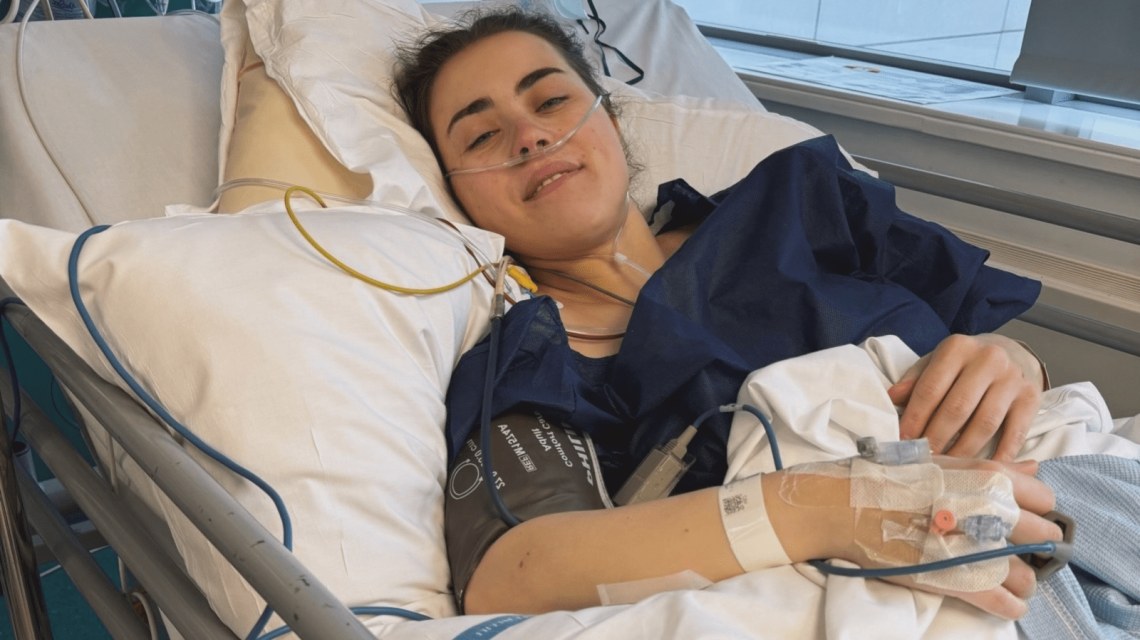
Mia Constantinou, 28, from Northern Ireland, experienced a shock after a soccer game. Playing for Ballymoney Ladies, she felt an intense pain described as a ‘lightning strike’ in her left leg. She also endured severe back pain that took her breath away. Despite her history with endometriosis and previous surgeries, she preferred avoiding hospitals unless necessary. Her partner, Alexs, persuaded her to seek medical help.
At the hospital, doctors examined her leg and provided suppository medication for pain relief before sending her home. Mia continued playing soccer and working as a healthcare assistant, but her pain worsened over the months. She scheduled a physiotherapy appointment. The physiotherapist was skeptical about the need for an MRI, dismissing Mia’s plea, ‘I doubt anything will be on it, but OK.’
Despite the initial doubts, Mia was referred for a spine and lumbar MRI scan in November 2025. She reviewed her MRI images using a clinic app, comparing them with online scans. While waiting for official results, she grew anxious, convinced something was amiss. The MRI revealed multiple issues, including vertebra fractures, a slipped vertebra, a bulging disc, joint inflammation, nerve narrowing, nerve pressure, a benign growth, and a cyst in the spinal canal.
In April 2026, Mia underwent an L5/S1 spinal fusion to join two lower spine bones permanently. She hoped for a quick recovery, but the post-surgery pain was intense. ‘Every movement felt worse,’ she described. Hospital physiotherapists urged her to walk. Mia felt disconnected from her own body. ‘How, eight or nine months prior, was I so active and healthy?’ she wondered.
Mia was discharged a week later. At home, she faced numerous changes. Her bed was moved downstairs, she used a recliner chair and a commode for basic needs. Despite undignified moments, Mia focused on recovery. New back pain emerged, and she learned a vertebra above her fusion had slipped. The condition, retrolisthesis, resulted from weakened stabilizing structures post-surgery, a study from Orthop Surg 2026 confirmed.
Mia faced more surgery in July. Her walking ability had deteriorated, requiring a wheelchair. Severe nerve pain persisted even after a second operation, necessitating yet another major spinal fusion. Post-surgery, she managed to walk further than she had in months without neuropathic pain. ‘I was so excited,’ she stated.
Eight weeks after the latest operation, Mia continues managing pain with morphine for degenerative disc disease. A community physiotherapist aids her walking and independence. ‘I feel heartbroken and grieve the life I once had,’ she expressed. Her advice unreservedly urges: ‘Listen to your body. Don’t take no for an answer regarding your health.’
For further contact on this story, reach out to Newsweek editors Kara Dolman and Emma Lee-Sang.
 Reducing Ultra-Processed Foods Improves Mental Health
  Link Between Ultra-Processed Foods and Chronic Disease Risks
  Senate Democrats Question if Kennedy Struck Deal in Vaccine Lawsuit
  Understanding Menopausal Brain Fog: Hormonal Shifts and Memory
  Concerns Over Kratom’s Health Risks Following Student Deaths
  Impending Changes to SNAP and Medicaid: Impact and Reactions