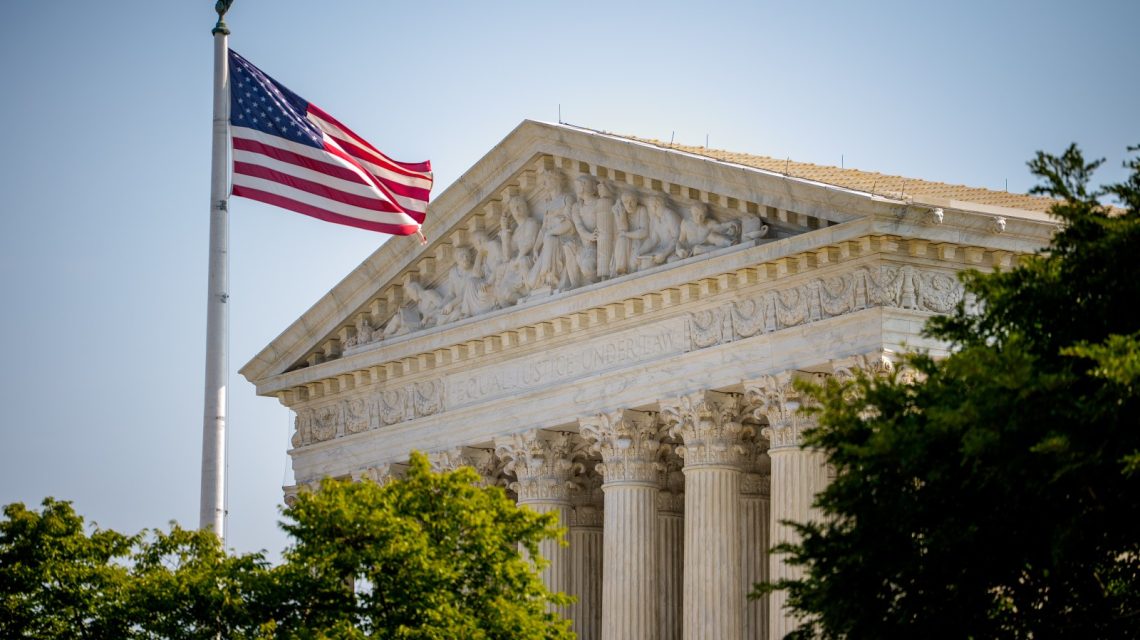
The United States Supreme Court has rejected an appeal from Missouri state leaders. They aimed to use a congressional district map from the recent primaries for the upcoming November midterm elections. This map was supported by President Donald Trump, but the dispute has garnered significant attention due to its broader election-law implications.
Supreme Court’s Decision
Missouri Attorney General Catherine L. Hanaway argued that changing the map this late could result in a “federal-election-administration disaster.” Despite these concerns, Justice Brett Kavanaugh denied Missouri’s request, affirming the state’s Supreme Court order to revert to a 2022 map.
Abha Khanna, from Elias Law Group, expressed approval of the decision. She emphasized that state law allows Missourians to decide on congressional map alterations without undue influence.
“This is a win for democracy and for the hundreds of thousands of Missourians who signed a petition,” Khanna stated.
The case has potential implications beyond Missouri, as other states might attempt to adjust their congressional maps, impacting national discussions on election processes.
Background on Missouri’s Map Controversy
The controversy began when the Missouri legislature passed House Bill 1 in September 2025, replacing a map from 2022. The new map was employed in the August 2026 primaries, where about 1.2 million voted.
Following its adoption, Richard von Glahn and People Not Politicians initiated a referendum campaign to challenge the map. This led to a legal dispute over whether the referendum process applied to redistricting.
The Missouri Supreme Court later reversed a lower-court decision, instructing the state to use the 2022 map instead.
Rationale Behind the Appeal
Missouri contended that altering district boundaries post-primary would force some voters into districts where they had not participated in nominating candidates. The state argued such changes would create impractical and chaotic election conditions.
Despite these arguments, Justice Kavanaugh allowed the Missouri Supreme Court’s decision to stand, leaving certain legal questions unresolved.
Richard von Glahn remarked on the ruling’s significance, stating it reinforces the authority of the Missouri constitution and the will of over 305,000 voters who opposed the new map.
Constitutional Arguments Presented
Republicans raised several constitutional challenges, including claims regarding the Elections Clause. They argued that Missouri’s redistricting process should not be derailed by a small voter fraction’s petition before a statewide vote.
They also claimed that redistricting between election phases violated Article I and equal-protection principles, unfairly treating voters shifted to new districts.
Supporting groups described the Missouri Supreme Court’s ruling as causing electoral chaos at the behest of a minority of voters.
National Relevance and Future Considerations
This case draws national attention to the timing of court interventions in election processes. Missouri and Republican groups voiced concerns about potential map changes after primary elections elsewhere if legal challenges persist.
The Purcell principle, often cited to caution courts against election-rule changes close to elections, was heavily emphasized in Missouri’s arguments.
Although Kavanaugh did not provide reasons for refusal, the case underscores tensions among state referendum systems, legislative control over districts, and judicial involvement in election administration.
Currently, Missouri election officials must comply with the Missouri Supreme Court’s order, maintaining the established 2022 map while awaiting further developments in this critical election-law dispute.
 Deadly Miami Cargo Plane Crash: Brake Systems Fails Analysis
  Search Ongoing for Missing Woman After Vehicle Crash in Calumet River
  Kauai Residents Prepare for Hurricane Lowell
  Fatal Fall in Colorado: Climber’s Tragic Incident at Castle Peak
  Union Workers Parade on Labor Day in Wilmington Amid Concerns
  Amazon Cargo Plane Crash at Miami International Airport