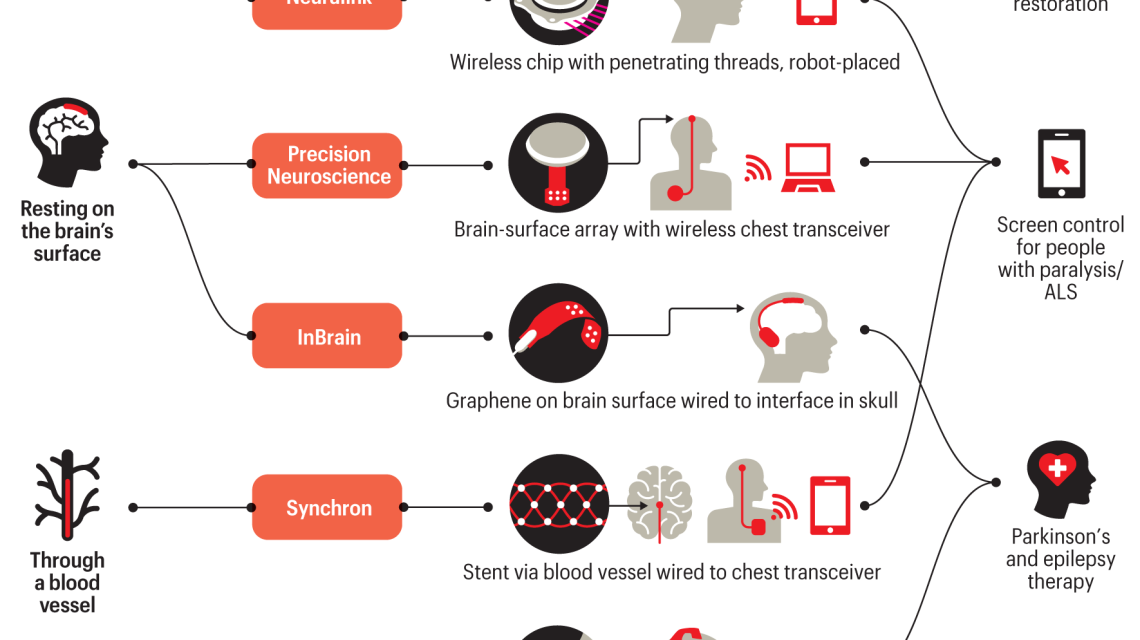
A robotic arm performs a delicate operation: drilling a circle in a patient’s skull and placing a coin-sized device on brain tissue. Attached are 64 hair-thin wires. These electrodes pick up signals from neurons, transmitting data to a phone or tablet. The patient can communicate, browse social media, and play games without any physical movement. This is the N1 implant by Neuralink, the brain-computer interface (BCI) company founded by Elon Musk.
Neuralink’s technology, still in testing with about 26 users, is designed for people with severe disabilities. Musk’s vision, since founding the company in 2016, extends further. In 2017, he stated that connecting our brains to technology is essential to keep pace with artificial intelligence (AI) and to avoid being rendered obsolete. By 2025, Neuralink reached an approximate valuation of $9.7 billion.
The arrival of brain implants in the U.S. market could significantly impact the tech industry and society. BCIs might soon be common in daily life, bringing new business opportunities and requiring updated norms for use. The companies trailblazing these devices stand to tap into vast markets, not only for devices but also for the data they collect. For others, the question remains: What is gained by allowing corporates access to our private thoughts?
Nita Farahany, a Duke University professor, cautions that thoughts represent the last domain of true privacy. She warns of a future with brain transparency where organizations can access thoughts at will.
Numerous U.S. companies are developing BCIs, racing for FDA approval. Among them, Paradromics focuses on speech restoration, and Precision Neuroscience aims to assist the paralyzed. The competition is intense, with Neuralink having $1.3 billion in funding. Yet, Synchron, a competitor, is closely competing in FDA processes with a device requiring less invasive procedures.
Advances in AI have made BCIs more powerful, potentially enabling control over robots or AI by interpreting thoughts. Matt Angle, CEO of Paradromics, envisions BCIs predicting desires, like ordering food based on hunger without conscious thought. This technology will eventually become mainstream, altering workplace monitoring and productivity tracking.
The integration of AI and BCIs poses questions about privacy and surveillance. Farahany highlights the risks of increased surveillance, although current workplace monitoring already tracks employee activities and behaviors.
Sam Altman, OpenAI CEO and co-founder of Merge Labs, speaks of humanity’s ongoing ‘cyborgization’ through external devices and systems. By 2025, AI increasingly guides decisions, evident through ChatGPT’s widespread use.
The journey to BCI commercialization involves rigorous stages, from animal tests to human implants. If successful, FDA approval follows pivotal trials, leading to market entry with insurance assistance. The future could see immense progress, surpassing today’s capabilities. Already, the technology shows potential; Neuralink’s first user, Noland Arbaugh, paralyzed from a diving accident, has utilized his implant for gaming and writing.
Synchron, offering the less invasive Stentrode, competes by enabling users to interact with computers. With future enhancements, Synchron aims for broader market adoption, leveraging their unique technology.
Neuralink and Synchron compete with international companies, particularly in China, where the first commercial BCI was approved. This raises concerns about potential risks if U.S. consumers use foreign-manufactured BCI components.
The discussion on global standards for BCIs is gaining traction. In 2025, Unesco emphasized ethical BCI development, urging governments to protect mental privacy.
Farahany highlights the profound nature of merging AI with humans, asking where AI ends and humanity begins.
 Lego Fortnite Supply Llama: A Tween’s Dream Gift with Huge Savings
 Jensen Huang’s Controversy Highlights Challenges for Corporate America
 Federal Agencies Face Cybersecurity Challenges
 FBI’s Crime Database Faces Hacking Threat
 AI Companies Pioneering Workforce Transformation
 AI Claims Breakthrough in Solving the Riemann Hypothesis