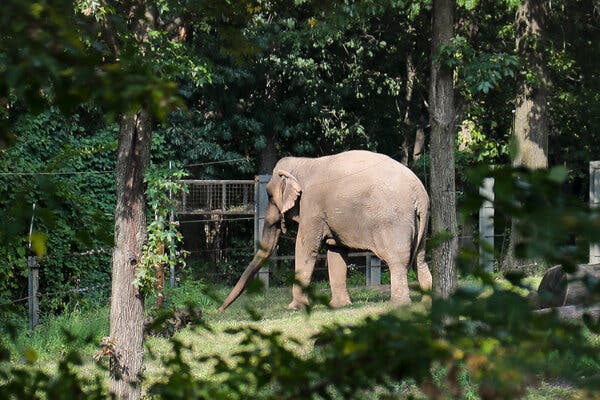
Happy, an Asian elephant residing at the Bronx Zoo for over 40 years, will stay there. New York’s highest court decided that Happy is not considered a person legally, and hence not eligible for fundamental human rights.
By a vote of 5-to-2, the Court of Appeals dismissed an animal rights group’s claim. They argued that Happy was being unlawfully confined and should be moved to an elephant sanctuary.
The case revolved around if the legal principle of habeas corpus, typically used to protect people from illegal detention, should apply to intelligent animals like elephants. The court ruled against this.
“While the impressive abilities of elephants are acknowledged, we reject the petitioner’s standing to seek habeas corpus relief for Happy,” wrote Chief Judge Janet DiFiore. “Habeas corpus is meant to secure the liberty of humans, not animals.”
However, Judge Rowan D. Wilson dissented, stating the court should “recognize Happy’s right to petition for her liberty not only because she is a wild animal, but because granting rights defines our society.”
In another dissent, Judge Jenny Rivera argued that Happy lived in an “unnatural environment” which prevented her from living as “a self-determinative, autonomous elephant in the wild.”
 Jacob Morley Recaptured After Escaping Prison
 Supreme Court Denies Arizona’s Request to Delay Prison Health Care Takeover
 Federal Judge Orders Release of Detained Canadian Dentist
 Philadelphia Police Watchdog Chair Accused of Witness Intimidation
 FCC Proposal to Jam Contraband Cellphone Signals in Prisons
 Challenges and Surveillance in Prediction Markets