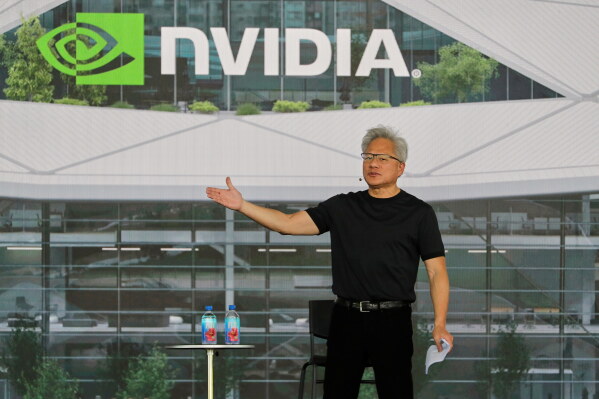
Jensen Huang, the CEO of Nvidia, highlights the unavoidable transformations AI will bring to society. In an interview with the Associated Press, he expressed optimism about AI’s potential to spur economic growth and scientific progress. However, he acknowledged concerns about job displacement and existential threats.
Huang believes society must adapt by creating new social norms. He advocates for widespread AI engagement, despite the technology’s emergence as a contentious issue, sparking debate over data center expansion and rapid adoption leading to possible job losses.
AI’s potential to democratize technology is significant. It lowers the barrier for advanced computer tasks, reducing the need for programming skills. Nonetheless, Huang insists that government regulation and safety standards are vital, with national security remaining a priority. AI’s impact on the economy, including stock market growth, underscores its importance.
“We need to create new social norms,” Huang said. “I would advocate that everybody use AI. Just go engage it.”
Response to Government Ownership of AI
Nvidia’s rising valuation highlights concerns of widening economic inequality. Suggestions for government ownership of AI firms, endorsed by figures like President Donald Trump and Senator Bernie Sanders, seek to address these concerns. However, Huang remains skeptical.
He argues that AI advancements inherently benefit American society through job creation, tax contributions, and investment returns. AI companies also boost profits for related industries, reinforcing the interconnectedness of American economic interests.
“I’m not exactly sure what they’re trying to achieve,” Huang stated about the idea of government ownership. “But just remember that these are American companies. Their success benefits the stock price, of which many Americans are investors in.”
Focus on National Security
The Trump administration’s recent shift towards stricter AI regulation, including export controls and voluntary government vetting of new models, earned Huang’s cautious support. He emphasizes the importance of clear guidelines to avoid unintended consequences, while maintaining national security as a top priority.
Huang warned against policies that could hinder American AI development, as seen in Nvidia’s opposition to export controls limiting chip sales to China. Such restrictions might provoke China to advance its own AI technologies, impacting the global ecosystem.
Challenges in AI Energy Consumption
Huang points to energy infrastructure as a significant challenge for AI development in the U.S. The computational demands of AI data centers create a heavy burden on electricity resources. While some centers may develop independent power sources, the U.S. is currently at a disadvantage.
He expressed concern over the country’s historic undervaluation of energy production, suggesting that this hinders U.S. competitiveness in AI infrastructure. Huang praised Trump’s approach to increasing energy production, despite not addressing his views on climate-friendly energy sources.
Huang’s remarks came during a factory expansion announcement in Sherman, Texas, to develop new technology aimed at reducing AI systems’ power consumption by half, marking a step toward mitigating energy-related challenges.
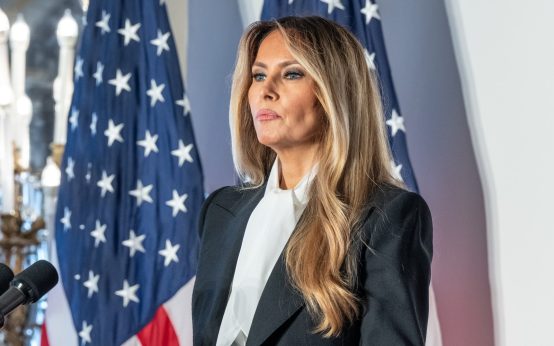 First Lady Melania Trump’s AI Education Push Amid Concerns
  Expansion of Data Centers Fueled by AI Development
 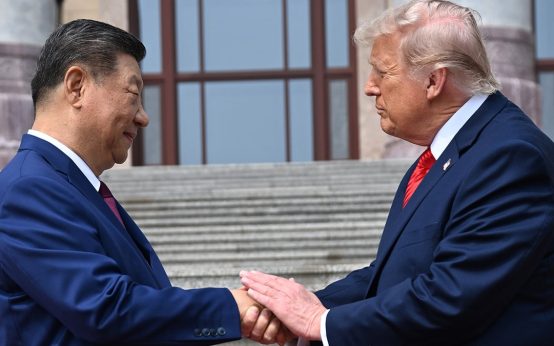 Beijing’s Tactical Undermining of U.S. Supremacy Through AI
 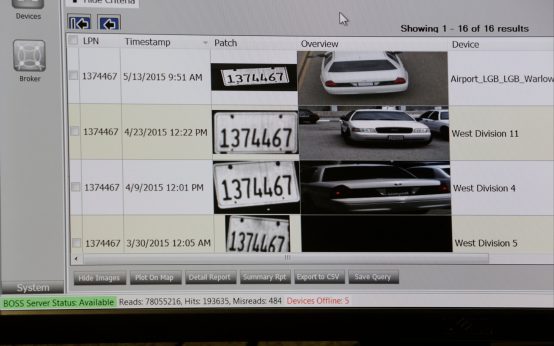 Controversy Surrounds Automated License Plate Readers Across the U.S.
  Trump and Harp Sued Over Truth Social Subscriber Program
  Implications of AI in College Admissions