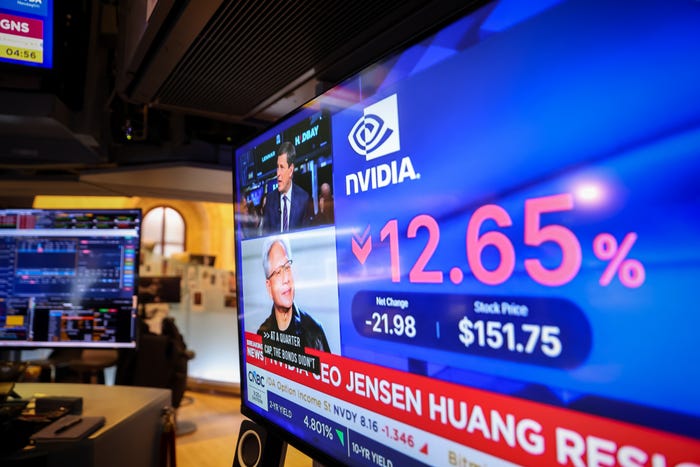
Nvidia’s recent stock troubles are causing ripples in the global AI trade, particularly affecting Asian markets before the company’s earnings report. Notably, South Korea’s Kospi index saw a 4% drop due to significant losses in major companies like Samsung Electronics and SK Hynix, which fell by 4% and 8%, respectively.
The impact was also visible in Taiwan, where the Taiex index decreased by 6%. Key Nvidia partner TSMC experienced a similar 6% decline. Other companies such as MediaTek and ASE Technology followed this downward trend in the region.
In Japan, chipmakers faced steep declines, with Kioxia down 8%, Tokyo Electron falling 7%, and Advantest dropping 11%. Meanwhile, Hong Kong’s tech stocks saw slight recovery after last week’s slump triggered by fears of Nvidia encountering potential US chip-export restrictions.
This regional reaction is connected to Nvidia’s own challenges, with the stock decreasing 2% to $162.85 on Friday, culminating in a weekly loss of nearly 13%. Nvidia has experienced about a 33% stock value drop since October, partly due to cofounder Jensen Huang’s resignation as CEO.
Nvidia’s reliance on TSMC and South Korean companies like SK Hynix and Samsung Electronics for chip production and memory has fueled significant stock market rallies. However, investors are worried about whether ongoing uncertainties at Nvidia might interrupt orders and infrastructure investments, affecting anticipated gains.
LSEG data predicts Nvidia’s third-quarter revenue could hit $109 billion, with a 90% rise in earnings. Despite potentially successful quarterly results, market confidence in Nvidia’s future plays a crucial role in stock valuation stability.
Chris Weston of Pepperstone highlights that confidence erosion can impede share price recovery, even with robust earnings. Investors are shifting focus toward Nvidia’s long-term prospects amid concerns over its leadership and staying competitive in the market.
This scenario emphasizes the significance of Nvidia’s forward guidance over immediate quarterly outcomes. Observers will look for indications of adjusted chip order and delivery timelines, impacting Asian suppliers heavily reliant on Nvidia.
Charu Chanana, from Saxo, notes that management’s caution around future demand might outweigh headline successes. Updates on Nvidia’s Blackwell chips and the next-gen Rubin processors are crucial, as investors seek assurance that production and distribution remain on track.
 Protests Rise in Spain Against Data Center Expansion
 Lego Fortnite Supply Llama: A Tween’s Dream Gift with Huge Savings
 Jensen Huang’s Controversy Highlights Challenges for Corporate America
 Federal Agencies Face Cybersecurity Challenges
 FBI’s Crime Database Faces Hacking Threat
 Neuralink’s Impact on Brain-Computer Interfaces