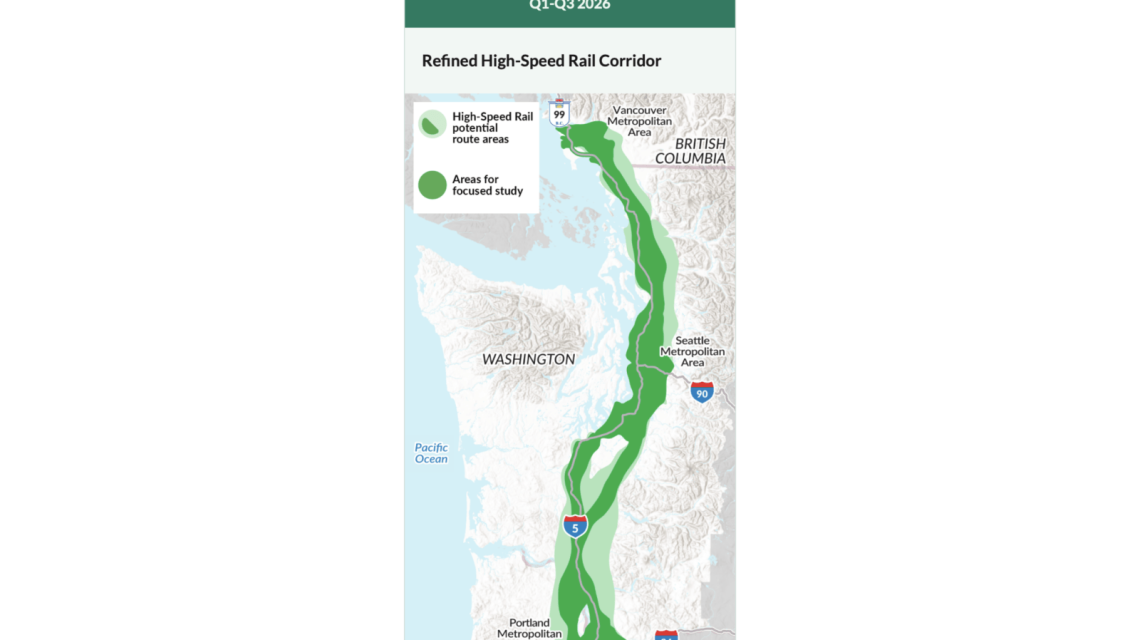
A long-term plan has been introduced for a high-speed railway project designed to connect three major metropolitan areas in the Pacific Northwest. This network aims to link cities across two U.S. states and extend into Canada. The proposed Cascadia High-Speed Rail system envisions a route within the wider Cascadia region, connecting Portland, Oregon; Seattle, Washington; and Vancouver, British Columbia. The Washington State Department of Transportation (WSDOT) has released a conceptual map showing the corridor stretching from the Portland metro area north through Washington to Vancouver.
The project is in its early stages, with no final route or station selections yet. WSDOT invites feedback from residents, businesses, and travelers through an online survey open until November 13. This input will inform the planning for the future transportation system in the region.
Understanding the Cascadia High-Speed Rail Plan
The high-speed railway is a strategy to improve connectivity between major Pacific Northwest cities amid regional growth. The network will link the metropolitan areas around Portland, Seattle, and Vancouver, B.C., establishing a high-speed connection across the U.S.-Canada border. WSDOT collaborates on this project with the Oregon Department of Transportation, Oregon Metro, and British Columbia’s Ministry of Transportation and Transit. This proposal integrates into WSDOT’s broader Cascadia High-Speed Rail and I-5 Program, which includes plans for Interstate 5 improvements and a unified approach to regional transportation involving roads, rail, airports, and transit.
In December 2024, the Federal Railroad Administration awarded WSDOT $49.7 million to develop a Service Development Plan. Additionally, the Washington State Legislature provided $5.5 million in matching funds. This phase of the project will extend until 2028.
Potential Train Stops
While the conceptual map highlights Portland, Seattle, and Vancouver as key metropolitan centers for the system, specific stations haven’t been confirmed. WSDOT’s Service Development Plan will explore potential routes, service options, stop numbers, and frequency of train operations. Governance and financing options will also be considered. The development plan, set for completion in 2028, will not finalize a preferred route or station locations, leaving places near the suggested corridor as tentative possibilities.
Reasons for the Proposal
The Pacific Northwest is projected to grow by 3.4 million people by 2050, with expanding industries like technology, aerospace, health care, and logistics. Existing transport infrastructure will face increased demand. WSDOT projects that by 2050, 80% of I-5 in Washington will have medium to high congestion, compared to 59% today. Truck trips are expected to rise by 50 to 67% by the same year. In Portland, 78% of I-5 is projected to suffer severe congestion by 2045, up from 33% in 2019.
No single transportation solution will meet future demands. Highways, rail, transit, and other modes must integrate to address regional needs effectively.
Challenges and Lessons from California
The Cascadia project is years from construction. California’s high-speed rail journey highlights challenges and costs in realizing ambitious rail plans. Construction has been underway in the Central Valley, yet the envisioned San Francisco-to-Los Angeles route remains incomplete. The California Rail Authority’s current plans prioritize a Merced-to-Bakersfield segment with service anticipated in 2033.
The project involves significant work, with $8.10 billion spent in the Central Valley as of mid-2026, covering 66 completed structures and 90 miles of guideway. Cost control measures have led California to revise tactics, streamlining station design and infrastructure.
For Cascadia, construction remains a distant goal. WSDOT must now determine the viability, routes, service patterns, and public preferences for the region’s high-speed rail network.
 Early Research Suggests Bans Aren’t the Solution for Social Media Issues
 Social Connections Thrive in Remote Work
 The Impact of Social Media Lawsuits in 2026
 Memphis Officials Consider Temporary Halt on Data Center Expansion Amid Protests
 SpaceX’s Profitable Quarter and Future Outlook
 The Legal Challenges Facing AI Regulation