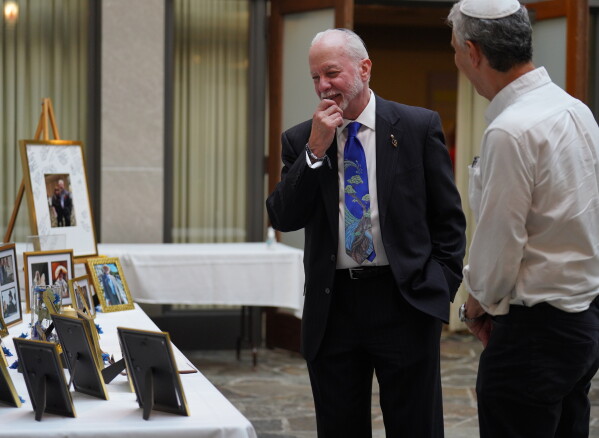
As the sun descends over Kochi’s historic Jew Town neighborhood, Keith Hallegua, wearing a gray kippah, walks alone to the ancient synagogue at the end of his street. It is Shavuot, the Jewish festival commemorating the giving of the Torah to Moses. Reaching the 458-year-old Paradesi Synagogue, Hallegua knows he will pray by himself without the traditional quorum of ten males required for communal services. He is the last Jewish resident in Jew Town.
At the Kadavumbagam Synagogue, Elias ‘Babu’ Josephai recalls the ‘chukkunda’ his grandmother used to make for Shavuot, a simple but significant memory. Both men show a deep sense of loss for what has disappeared and strive to protect what remains.
In the 1950s, most of the Jewish community in Kochi, historically known as Cochin, moved to Israel, leaving behind their homes, synagogues, and cemeteries. Hallegua and Josephai stayed, representing the final chapter for Cochin Jews, who have lived harmoniously alongside Hindu, Muslim, and Christian neighbors for centuries. Currently, there are fewer than 5,000 Jews in India.
The history of Cochin Jews is complex, marked by religious freedom and internal divisions over class and colorism. Hallegua belongs to the Paradesi Jews, known for their Sephardic ancestry fleeing the 16th-century Spanish Inquisition. They brought enslaved people whose descendants, the Meshuchrarim Jews, faced discrimination and fought for religious equality.
Josephai is a Malabari Jew with lineage tracing back over 2,000 years. This group also suffered discrimination from the Paradesi community. Though these divisions dissipated after migration, their effects linger in the community’s legacy.
Despite seldom meeting, Hallegua and Josephai take pride in their heritage. Josephai dedicated years to restoring the Kadavumbagam Synagogue, the last operating Malabari synagogue. Although services are rare, he maintains the traditions and reflects on past gatherings filled with prayer and song.
Hallegua is the Paradesi Synagogue’s last local congregant, relying on visitors for the required numbers. He frequently questions himself, feeling the weight of his role and the absence of fellow worshipers.
Preservation Efforts
On a recent day, tourists explored the Paradesi Synagogue and Synagogue Lane, once a thriving part of the Jewish community’s spice trade. The synagogue features historic tiles, chandeliers, and a Torah ark. Visitors adhere to local customs by removing their shoes.
Synagogue trustee M.C. Praveen, a Hindu, grew up in Jew Town. His mission is preserving Cochin Jewish history. He maintains contact with former residents and aims to keep the town’s cultural memory alive.
Shulamit Kotzer, born in Jew Town before moving to Israel, dreams of opening a hotel in the area. Earlier this year, the synagogue inaugurated a museum showcasing Kochi’s Jewish history, including an original deed granting religious freedom.
Cross-Community Connections
Praveen isn’t the only non-Jew committed to preserving Jewish culture. Thaha Ibrahim, a Muslim, was close to Sarah Cohen, a Jewish neighbor who taught him traditional embroidery. He now runs her shop and honors her legacy by teaching his son the craft.
In Ernakulam, Josephai continues to protect Malabari Jewish heritage. He restored the Kadavumbagam Synagogue with help from people of different faiths. A plaque showing the Ten Commandments was a Christian gift, while a Hindu foundation funded the chandeliers. Josephai upholds his promise to maintain the synagogue’s prayers, a pledge made to his grandmother.
Thapan Dubayehudi, a Malabari Jew now in Vienna, calls Josephai a ‘one-man army’ preserving history. He cherishes the memories of lighting lamps during Hanukkah under Josephai’s guidance.
Identity and Legacy
Keith Hallegua, who remained to care for his family, didn’t expect to be the last Jew in Jew Town. His memories are vivid, filled with cultural traditions and family gatherings. While memories fade, his connection to his homeland remains steadfast.
Hallegua emphasizes his identity, stating, ‘I was born a Jew in India and I shall die in India, a Jew.’
The Associated Press provides this content through collaboration with The Conversation US, supported by funding from Lilly Endowment Inc.
 Rose Friedman: A Dedicated NPR Journalist Remembered
  Notable Lost Stories and Objects
  Protesters Rally at Lucas Museum Opening for Worker Protections
  Grieving Father Patrick Clancy Sheds Light on Family Tragedy
  The Role of Family in Personal Recovery
  The Unique Education Model of Cristo Rey Jesuit High School