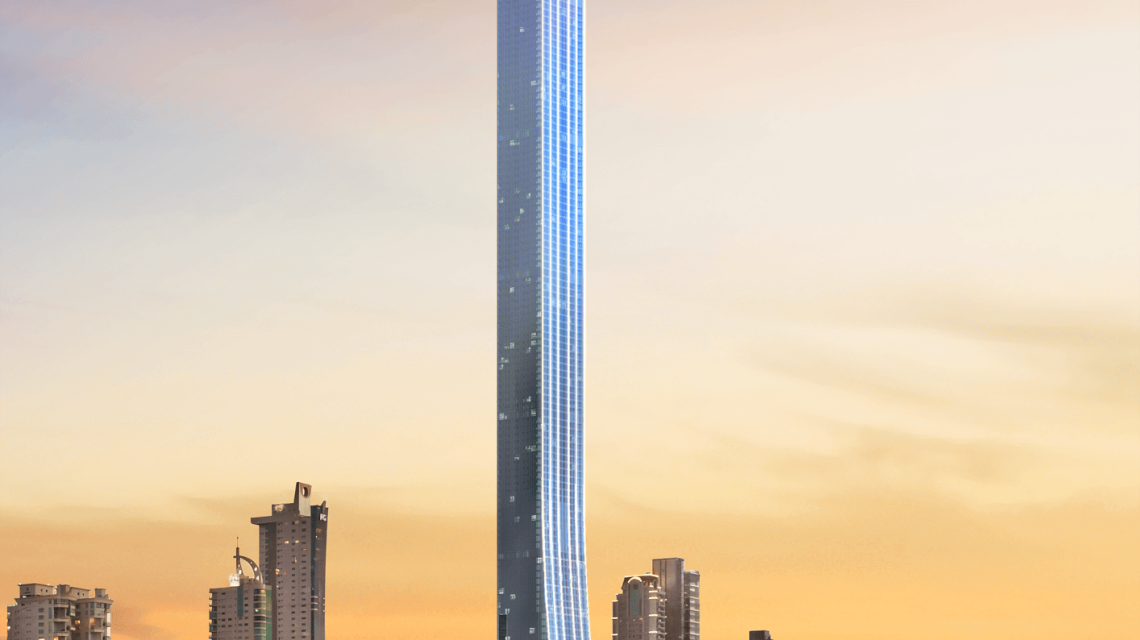
The Senna Tower, under construction in the coastal city of Balneário Camboriú, Brazil, is poised to become the world’s tallest residential tower. Stephane Domeneghini, a civil engineer and executive director of Talls Solutions, is leading the project, which will reach over 550 meters, surpassing even the One World Trade Center in New York City. This milestone places it as the tallest building outside Asia, based on height data from The Skyscraper Center of the Council on Vertical Urbanism.
Domeneghini highlights a critical phase of the construction involving a foundation system specifically designed for this impressive height. This phase included the installation of 798 auger cast piles under the main foundation mat. Each pile measures 60 centimeters in diameter and extends 27 to 44.5 meters into bedrock. With the completion of these foundation piles, construction can proceed on the massive concrete foundation mat for the tower’s superstructure.
“This milestone follows more than four years of research and an extensive program of testing and validation,” Domeneghini explains. The collaboration involved Talls Solutions, FG Empreendimentos, and specialist consultants.
Global Skyscraper Race
The Senna Tower is among several ambitious projects worldwide. The Jeddah Tower in Saudi Arabia is expected to become the world’s tallest building by 2028, exceeding one kilometer in height. China’s Tianjin 117 is another significant project nearing completion, known as the world’s tallest empty skyscraper. In the US, the 2 World Trade Center in New York is currently the tallest under construction, expected to rise 1,226 feet by 2031. The Waldorf Astoria Hotel & Residences Miami will claim the title of Florida’s tallest building at 1,049 feet in 2028.
Engineering Challenges
Domeneghini points out the site’s geotechnical complexity as a major challenge for the Senna Tower. The site features layers of sand, silt, and soft clay, along with residual soil and bedrock at varying elevations. The foundation design needed to accommodate these challenges by transferring exceptional loads and ensuring long-term stability. Talls Solutions and FG Empreendimentos developed an auger cast pile solution unique in scale for supertall buildings.
The solution stemmed from over four years of research, assessing six foundation types, and conducting two full-scale test sites. Tests included loading piles with up to 2,000 metric tons-force and using fiber-optic instrumentation to monitor behavior. Australian geotechnical specialist Professor Harry Poulos reviewed the foundation plans, bringing expertise from projects like Dubai’s Burj Khalifa.
Construction logistics also present challenges, with work limited to weekdays from 7 a.m. to 5 p.m., unlike 24-hour schedules in places like New York, Dubai, and China. To navigate these constraints, the team uses 4D planning to link building information modeling (BIM) with scheduling, allowing for efficient coordination of equipment and activities.
The showcase of the tower’s superstructure is anticipated by the end of next year, with complete construction expected in six to seven years.