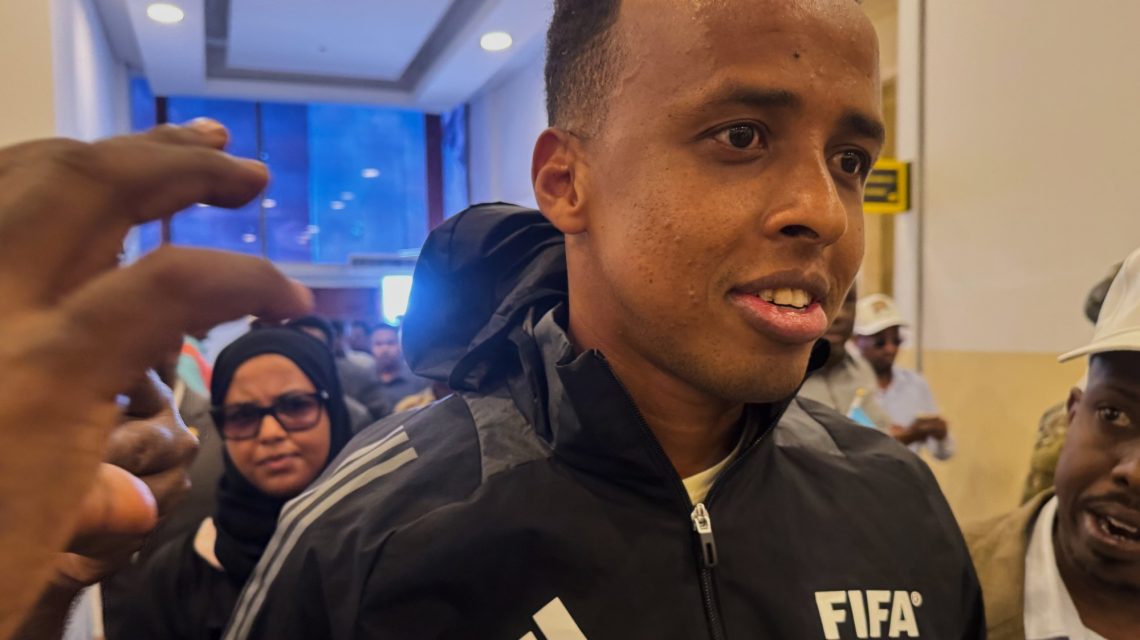
Referee Omar Artan, who was unable to enter the United States, returned to Mogadishu, Somalia, on Wednesday, June 10, 2026. He arrived to a warm reception from supporters and officials in the capital. Artan expressed his intention to participate in the next World Cup and encouraged Somali youth to take pride in their country.
Artan was poised to become the first Somali referee at a World Cup, having been included in FIFA’s final list for the event. Recognized as one of Africa’s leading referees, he was named the continent’s top male referee in 2025. Despite having a visa, he was denied entry at Miami International Airport over unspecified “vetting concerns,” as stated by U.S. Customs and Border Protection. Following this, FIFA removed him from the tournament’s referee list.
The Somalia Embassy in Kenya had processed Artan’s visa the previous week. The U.S., co-hosting the World Cup with Mexico and Canada, was to be Artan’s destination to join other referees for training in Miami. His return to Mogadishu was met with admiration and support as he thanked the Somali government, its people, and FIFA.
“I promise you, God willing, that I will attend the next one,” Artan stated as supporters with Somali flags cheered around him. “I want the Somali public to take comfort in this and remain confident.”
Somali Prime Minister Hamza Abdi Barre acknowledged Artan’s achievements, stating on X that Artan “already won the hearts of millions and secured his place in history.”
The denial of entry to a FIFA-appointed match official by a World Cup host country led to global outrage and raised concerns about America’s capability to host the event. Somalia is one of nearly 40 countries affected by new travel restrictions under the Trump administration’s immigration policies. In light of these events, the United Nations’ top human rights official called for a comprehensive review of immigration policies, particularly in the U.S.
At Aden Adde International Airport, hundreds of supporters, government officials, and football community members gathered to welcome Artan. As he disembarked, supporters, bearing Somali flags, surrounded him and draped him in the flag. He then met with Somalia’s sports minister and other dignitaries in the airport’s VIP terminal, where he addressed journalists.
“It is up to all of us to defend the Somali name,” Artan emphasized. “Somalia belongs to us, whether it is in a bad state or a good state. That flag belongs to us, and that passport belongs to us.”
Artan’s situation highlighted challenges faced by many in Somalia due to years of conflict and the threat from the extremist group al-Shabab. Yet, his journey served as a reminder of the potential achievable when pursuing dreams.
The World Health Organization Director-General Tedros Adhanom Ghebreyesus from neighboring Ethiopia lauded Artan on X. He acknowledged that Artan had reached the peak of his profession and inspired a generation despite the setback. You reached the summit of your profession and inspired a generation back home just by getting there, and being kept off the pitch you earned doesn’t change that.
 Cubs and White Sox in Playoff Race
  Twitch Streamer Hasan Piker Discusses Controversial Commentary
  Discussion on NFL Draft Comparison and Simone Biles’s Car Issue
  A Shifting Political Landscape: The Decline of Autocratic Power
  Chicago White Sox’s 2026 Success and Team Dynamics
  Trump Delivers Warning to Iran, Cuba at UN General Assembly